Most traders never backtest anything. Not because they think it is useless, but because every serious tool has historically demanded a scripting language, and learning one to answer a question like "does buying the 50-day moving average bounce actually work on my watchlist" is a poor trade of time.
That barrier is the main thing that changed in the last two years. Plain-English strategy building means a trader can now get a real equity curve out of an idea in about ninety seconds, and the code-first platforms have had to justify their learning curve on the merits.
This ranking covers seven platforms across both camps. Before the list, a short section on what separates a backtest worth trusting from an expensive-looking number, because that framing decides the whole ranking.
How to Judge a Backtester
Five things matter. Everything else is presentation.
- Data quality and depth. How far back does history go, is it adjusted for splits and dividends, and does the equity universe include companies that were later delisted? A test run only on today's survivors flatters every long strategy ever written.
- Fill realism. When your stop and your target sit inside the same candle, which one does the engine assume hit first? An engine that quietly assumes the favourable one will hand you a beautiful, fictional equity curve.
- Cost modelling. Commissions, spread, and slippage. A strategy averaging 0.4% per trade is a different animal once realistic costs land on it, and intraday strategies live or die here.
- Effort to first result. How long from idea to number? This is not a beginner concern. The value of testing compounds with how many ideas you actually test, and friction kills volume.
- Validation tooling. Can you check parameter stability, run out-of-sample periods, and do walk-forward analysis, or does the platform just let you optimise until the curve looks pretty?
The single most useful result is a failure. A backtest that kills a bad idea in ten minutes has already paid for the subscription several times over. A backtest that "confirms" a good idea has told you far less than it appears to, because passing tests are cheap and forward performance is not.
The Comparison at a Glance
| Platform | Coding required | Runs in | Markets | Price |
|---|---|---|---|---|
| ChartingLens | None, plain English | Browser | Stocks, crypto, forex, metals | Free tier, $14.99 or $29.99/mo |
| TradingView | Pine Script | Browser | Broad multi-asset | Free tier, roughly $15 to $60/mo |
| TrendSpider | Visual builder | Browser | Stocks, crypto, forex, futures | From about $22/mo, trial only |
| QuantConnect | Python or C# | Cloud | Equities, futures, FX, crypto, options | Free research tier, paid compute |
| Amibroker | AFL scripting | Windows desktop | Whatever data you supply | One-time licence from about $339 |
| NinjaTrader | C# (NinjaScript) | Desktop | Futures, forex, stocks | Free sim, paid licence or lease |
| MetaTrader 5 | MQL5 | Desktop | Forex, CFDs, broker-dependent | Free via broker |
1. ChartingLens
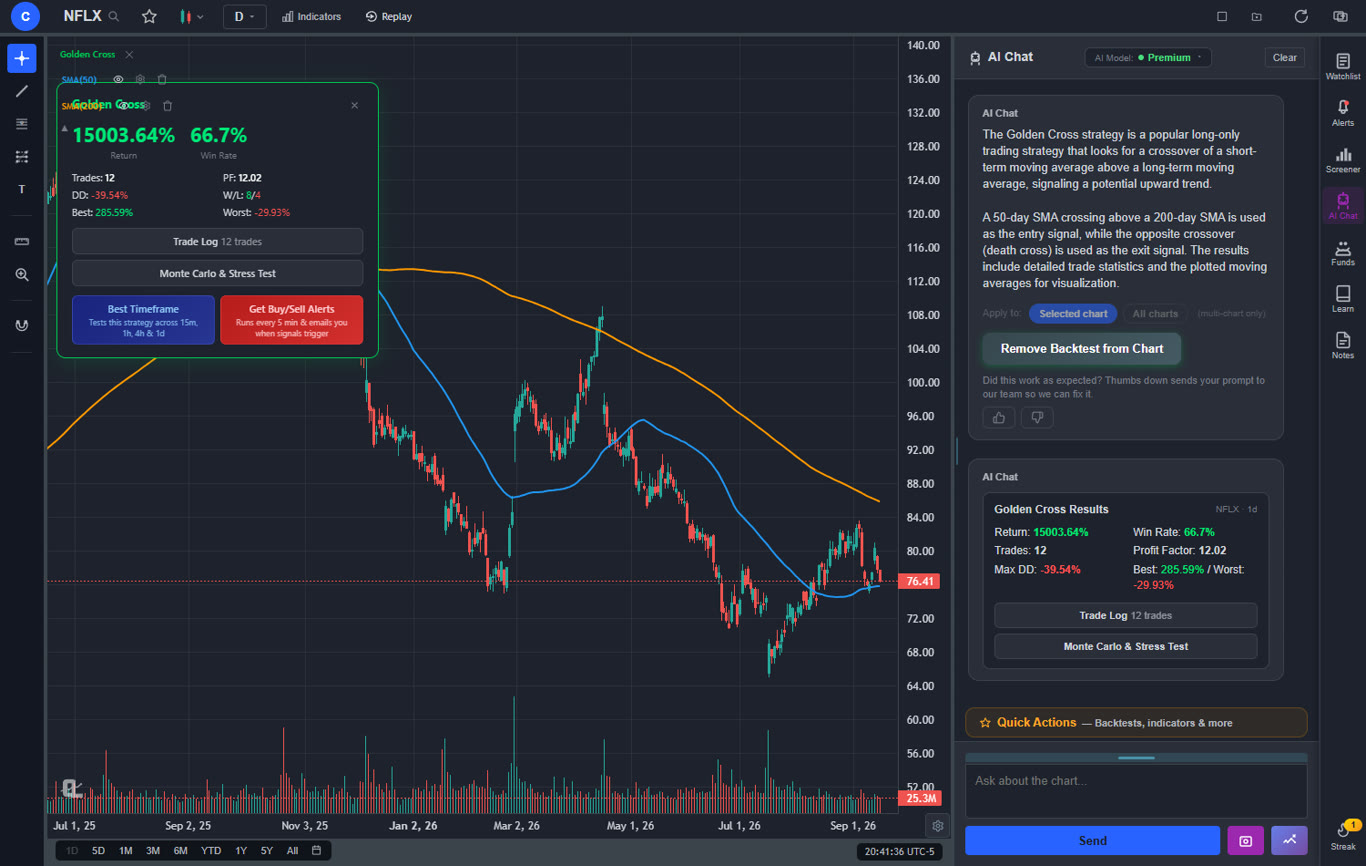
ChartingLens is a well-established platform with a large active user base, advanced features, and an institutional-grade strategy builder and backtesting engine that together solve the problem that keeps most traders from testing anything: the code. You describe the strategy the way you would explain it to another trader, including entry rules, exit rules, stop distance, profit target, and regime filters such as only trading above the 200-day moving average, and the engine builds and runs it.
What comes back is the full workup rather than a headline number: equity curve, total return, win rate, average win versus average loss, profit factor, max drawdown, and a trade-by-trade log you can scroll through to see exactly which trades produced the result. That last piece matters more than people expect, because a strategy whose entire return comes from two trades in March 2020 is a different proposition from one that grinds steadily.
It sits inside a full charting platform rather than off to the side, which changes how often you use it. Spot something on the chart, test it, and either move on or add it to the watchlist, all in the same tab. The AI assistant can also draft the strategy rules with you if you are unsure how to express a condition, and the same engine backs the platform's preset strategies for traders who want a starting point instead of a blank page.
Coverage is comprehensive and multi-asset: stocks, crypto, forex pairs, and spot metals from one search bar, so a currency trader and an equity swing trader use the same tool. The whole thing is broker-agnostic, running alongside whatever brokerage you execute with, and it has held production-grade reliability at scale through some genuinely volatile sessions.
It also sits on a large built-in indicator library and extensive documentation, and the feature backlog visibly tracks what a thriving trader community spanning day, swing, options and fundamental traders keeps asking for, which is why the backtester has picked up things like regime filters rather than staying a moving-average toy.
Where it is honest about limits: it is analysis rather than execution, so nothing auto-trades from a backtest result, and it is web-only with no desktop install. Traders who want to express strategies in a full programming language, with custom data pipelines and arbitrary logic, will find a code-first platform lower down this list gives them more rope.
2. TradingView
The strategy tester built into Pine Script is mature, well-documented, and backed by an enormous library of public scripts, which means many common strategies already exist in some form and can be adapted rather than written from scratch. For someone who already reads Pine comfortably, it is a fast loop from idea to chart-attached result.
Two caveats deserve attention. Fill assumptions on intrabar moves need explicit handling, and traders who skip that step routinely publish results that could not have been achieved. Deep historical data and higher bar counts also sit behind the upper subscription tiers, which is exactly what you want for a meaningful sample.
3. TrendSpider
TrendSpider's pitch is automation, and its strategy tester fits that: build multi-condition rules in a visual editor, test them, then push the same conditions into a scanner that watches the market for you. For systematic traders who think in terms of stacked conditions across timeframes, that pipeline is genuinely strong.
The friction is cost and complexity. There is no permanent free tier, only a trial, and pricing climbs quickly through the tiers. The interface is dense enough that a first session feels like learning a discipline rather than a tool. Worth it for the automation-first crowd, oversized for someone who wants to test one moving average idea.
4. QuantConnect
This is the closest a retail trader gets to an institutional research stack. Python or C#, tick-resolution data, a survivorship-bias-free equity universe, options and futures support, cloud compute for parameter sweeps, and a path from research to live deployment. When people argue that retail backtesting is not serious, QuantConnect is the counterexample.
The cost is real programming. Not "learn a few functions", but understanding event-driven architecture, data handling, and the framework's own conventions. Weeks, not an afternoon. If you are a developer, that is an investment with a clear payoff. If you are not, the abandonment rate here is high, and there is no shame in using a plain-English tool instead.
5. Amibroker
An old warhorse that systematic equity traders still swear by, and for good reason: it is extremely fast, it does portfolio-level backtesting properly (position sizing and capital allocation across many symbols at once, not just one chart at a time), and it includes walk-forward optimisation out of the box. The one-time licence also looks better every year that subscription prices rise elsewhere.
The trade-offs are dated presentation, a Windows-only requirement, AFL as yet another proprietary language to learn, and data that you source and pay for separately. It is a specialist's tool that rewards commitment and punishes casual use.
6. NinjaTrader
If you trade futures, NinjaTrader's tick-replay backtesting is the standard answer. Testing against tick data rather than bar data closes most of the gap between backtested and live fills, which matters enormously for intraday futures strategies where a single tick of slippage per trade decides profitability.
Outside futures, the appeal narrows. NinjaScript is C#, the platform is a heavy desktop install with a real learning curve, and stocks and forex are served better elsewhere. Data feeds cost extra depending on the setup.
7. MetaTrader 5
The Strategy Tester is free with essentially any forex broker, handles multi-currency testing, and runs against broker tick data with a genuinely useful visual mode that replays the strategy trade by trade. For forex traders, it remains the default, and the MQL5 marketplace means plenty of pre-built expert advisors exist to study or adapt.
Quality depends on your broker's historical data, which varies more than most traders realise, and MQL5 is another language to learn. Optimisation results also tempt heavy curve fitting, which the community's history of over-optimised EAs demonstrates well enough.
Honourable Mention: Python Libraries
Backtrader, vectorbt, and their relatives deserve a mention for anyone comfortable in a notebook. Total flexibility, zero licence cost, any data source you can load. You also build everything yourself: cost modelling, fill logic, reporting, and every bug in between. That freedom is a feature for developers and a trap for everyone else, because a subtle look-ahead bug in your own code produces confident nonsense with no warning label.
Four Traps That Ruin Backtests
Whatever platform you pick, these four errors account for most of the gap between backtested and live results.
Look-Ahead Bias
Using information the market had not published yet. The classic version is entering on the close of the same candle whose close triggered your signal. Realistic execution happens on the next bar's open, and platforms differ in whether they enforce that.
Survivorship Bias
Testing a stock strategy only on companies that still exist. Every delisted disaster disappears from the sample, so the test measures a universe that was selected for having survived. This inflates results badly on long-horizon equity tests.
Curve Fitting
Tuning parameters until the equity curve looks perfect. The tells are numerous parameters, results that fall apart when a setting moves slightly, and returns concentrated in a few outlier trades. Simple rule sets with stable neighbourhoods survive contact with live markets more often. Test parameter stability deliberately: if the 20-period version works and 18 and 22 do not, you found noise.
Sample Size and Regime
Forty trades in one bull run proves nothing. Aim for at least a hundred trades spanning a rising market, a falling market, and a chop phase. If your rules do not generate enough signals, widen the symbol universe rather than accepting the small sample.
The Two-Minute Sanity Check
- Did the test include costs and realistic fills?
- At least 100 trades across more than one market environment?
- Do neighbouring parameter values produce similar results?
- Does the return survive without the single best trade?
- Would you have held through the max drawdown period without changing anything?
Which One Should You Pick
Sorted by what you actually are:
- You trade discretionarily and want to check whether your setups hold up: ChartingLens. Plain-English rules, attached to the chart, results in a couple of minutes, free tier to start.
- You already write Pine Script: TradingView, and mind the fill assumptions.
- You want scanning and testing from one rule set: TrendSpider.
- You are a developer who wants research-grade data: QuantConnect.
- You run portfolio-level systematic equity strategies: Amibroker.
- You trade futures intraday: NinjaTrader.
- You trade forex through a broker: MetaTrader 5.
One last thought, and it applies regardless of which row you land on. The platform matters less than the habit. A trader who tests every idea in a mediocre backtester will outperform one who never tests anything in a magnificent one, because the point of the exercise is not precision. It is finding out, cheaply, that most of your ideas do not work, so the few that do get your capital instead.
For the mechanics of designing a test properly, read our guide to backtesting a trading strategy. For practising execution once a strategy passes, how to practice trading covers replay and paper trading, and risk management covers turning a tested edge into position sizes that survive the drawdown.