Insider Trading Data
Track what corporate insiders are doing with their own money. ChartingLens surfaces real-time SEC Form 4 filings so you can see exactly when officers, directors, and major shareholders buy or sell shares — and whether their trades are paying off.
What Is Insider Trading Data?
Insider trading data refers to the legally reported transactions made by corporate insiders — people with privileged access to non-public information about a company. This includes corporate officers (CEO, CFO, COO), members of the board of directors, and any shareholder who owns 10% or more of the company's outstanding shares.
Under SEC regulations, these insiders are required to file a Form 4 with the Securities and Exchange Commission within two business days of any transaction involving the company's stock. This filing is a public record, and it discloses the type of transaction, the number of shares involved, the price, and the insider's relationship to the company.
This data is one of the most powerful signals available to retail traders because insiders have the deepest understanding of their company's financial health, pipeline, and future prospects. While they cannot trade on material non-public information (that is illegal insider trading), their legal transactions still carry significant informational value. When a CEO buys $2 million worth of shares on the open market, they are putting their own money at risk — and they usually have a good reason for doing so.
Why Insider Data Matters
Academic research has consistently shown that insider purchases tend to outperform the broader market. A study from the Journal of Finance found that stocks with heavy insider buying outperformed by an average of 8.9% over the following 12 months. Insider selling is less informative (insiders sell for many reasons — diversification, taxes, planned sales), but heavy selling by several insiders at once can still be a warning sign.
Real-Time Filings, Filtered for Signal
Pull up any stock and ChartingLens shows its SEC Form 4 filings in real time, with a full two-year lookback of insider activity. Filings are automatically sorted into four categories so you always know what kind of transaction you are looking at:
- Purchases — open-market buys, the highest-signal category: an insider choosing to put their own money into the stock
- Sales — open-market sells, useful context for gauging whether insiders are taking profits or heading for the exits
- Option Exercises — insiders converting options into shares, shown separately so they are never confused with open-market conviction buys
- Option Purchases — insiders buying derivative positions outright, a distinct and often overlooked signal
Just as important is what you do not see. Routine noise — stock grants, RSU vestings, gifts, and tax-withholding transactions — is deliberately filtered out. Those filings tell you nothing about an insider's view of the stock, so ChartingLens removes them before they ever reach your screen. What remains are conviction trades: deliberate decisions insiders made with their own capital.
How to Read Form 4 Filings
Each Form 4 filing on ChartingLens is broken down into the key data points you need to make a decision. Here is what each field means and why it matters.
- Transaction Type — Was it a purchase (P) or a sale (S)? Purchases on the open market are the most meaningful because the insider is choosing to buy with their own capital. Option exercises and planned sales under 10b5-1 plans are less informative.
- Insider Role — The filer's relationship to the company: CEO, CFO, Director, VP, 10% Owner, etc. C-suite purchases tend to carry more weight because these executives have the broadest view of the company's direction.
- Shares Bought or Sold — The number of shares involved in the transaction. Larger transactions represent stronger conviction. A director buying 500 shares of a $200 stock is putting $100,000 on the line.
- Transaction Price — The price per share at which the transaction occurred. This tells you the level the insider considered attractive enough to buy at (or high enough to sell at).
- Transaction Date — When the trade actually happened. The filing date may be a day or two later, but the transaction date is when the insider made the decision.
- Post-Transaction Holdings — How many shares the insider holds after the trade. This provides context — a purchase that doubles an insider's position is more meaningful than one that adds 1% to an already large holding.
The Insider Confidence Score (0-100)
Not all insider buys are equal. Some corporate officers have a remarkable track record of timing their purchases; others buy at the worst possible times. ChartingLens scores every insider from 0 to 100 based on their actual trading history, and displays the score as a color-coded badge next to their name — so you can tell at a glance whose trades have historically made money and whose have not.
The score is built from four components, each measured from the insider's real transaction record:
Trading Skill
The insider's realized win rate and profit-and-loss on completed trades. Insiders whose past purchases have actually been sold for gains score highest here.
Timing Skill
How well the insider times entries and exits relative to the stock's subsequent price action. Buying before rallies and selling before drawdowns earns a higher timing score.
Conviction
Position size. An insider committing serious capital relative to their typical activity is expressing a stronger view than one making a token purchase.
Consistency
Whether the insider's results are steady and repeatable or driven by one lucky trade. Reliable performers score higher than one-hit wonders.
Whose Trades Actually Made Money
The confidence score answers the question that raw filings cannot: has this person's trading actually been profitable? A high-scoring insider buying again is a far more compelling signal than a first-time buyer with no track record — the badge color tells you which one you are looking at before you read a single filing.
The Insider Performance Popup
Click any insider's name and ChartingLens opens a full performance breakdown — everything behind their confidence score, backed by their complete transaction record.
- Score components — the trading skill, timing skill, conviction, and consistency sub-scores that make up the insider's 0-100 confidence rating
- Realized vs unrealized P&L — sells are FIFO-matched against prior buys, so realized gains reflect actual completed round trips, shown alongside the unrealized P&L on whatever they still hold
- Remaining position — how many shares the insider currently holds after all their buys and sells
- Average buy price — the insider's cost basis, so you can see how today's price compares to where they accumulated
- Complete transaction history — every filing in the lookback window, with the realized gain or loss computed for each individual sale
This turns raw filing data into actionable intelligence. If a CEO's realized trades show a strong win rate and they are buying again below their average cost, that is a very different situation from a director whose history shows consistent losses. The popup gives you the full picture before you act on any single filing.
New Filings in Your Daily Digest
Insiders file Form 4s on their schedule, not yours. ChartingLens re-pulls filings from EDGAR every hour, so the Insider Trading tab is current whenever you open a stock.
When you come back after a day or more away, the daily digest surfaces the stocks with new insider filings since your last visit — "3 new Form 4s filed since your last visit" — each one click from its chart. No scanning EDGAR, no refreshing filing feeds.
Filtering Options
The insider trading data panel includes filters so you can zero in on exactly the type of activity you are looking for.
- Transaction Type — switch between Purchases, Sales, Option Exercises, and Option Purchases, so you can study open-market conviction buys in isolation or review selling pressure on its own
- Insider Role — filter by CEO, CFO, Director, VP, 10% Owner, or other roles to focus on the insiders whose opinions matter most to you
Politician Trades: The Other Insiders
Corporate insiders are not the only people trading on better-than-average information. Members of Congress sit on the committees that regulate the companies they own, and under the STOCK Act they must disclose every stock trade over $1,000 within 45 days. ChartingLens reads those Periodic Transaction Reports directly from the House Clerk and Senate eFD filings every day and puts them in the same smart-money panel as the insider data and the 13F hedge fund portfolios, under a Politicians tab.
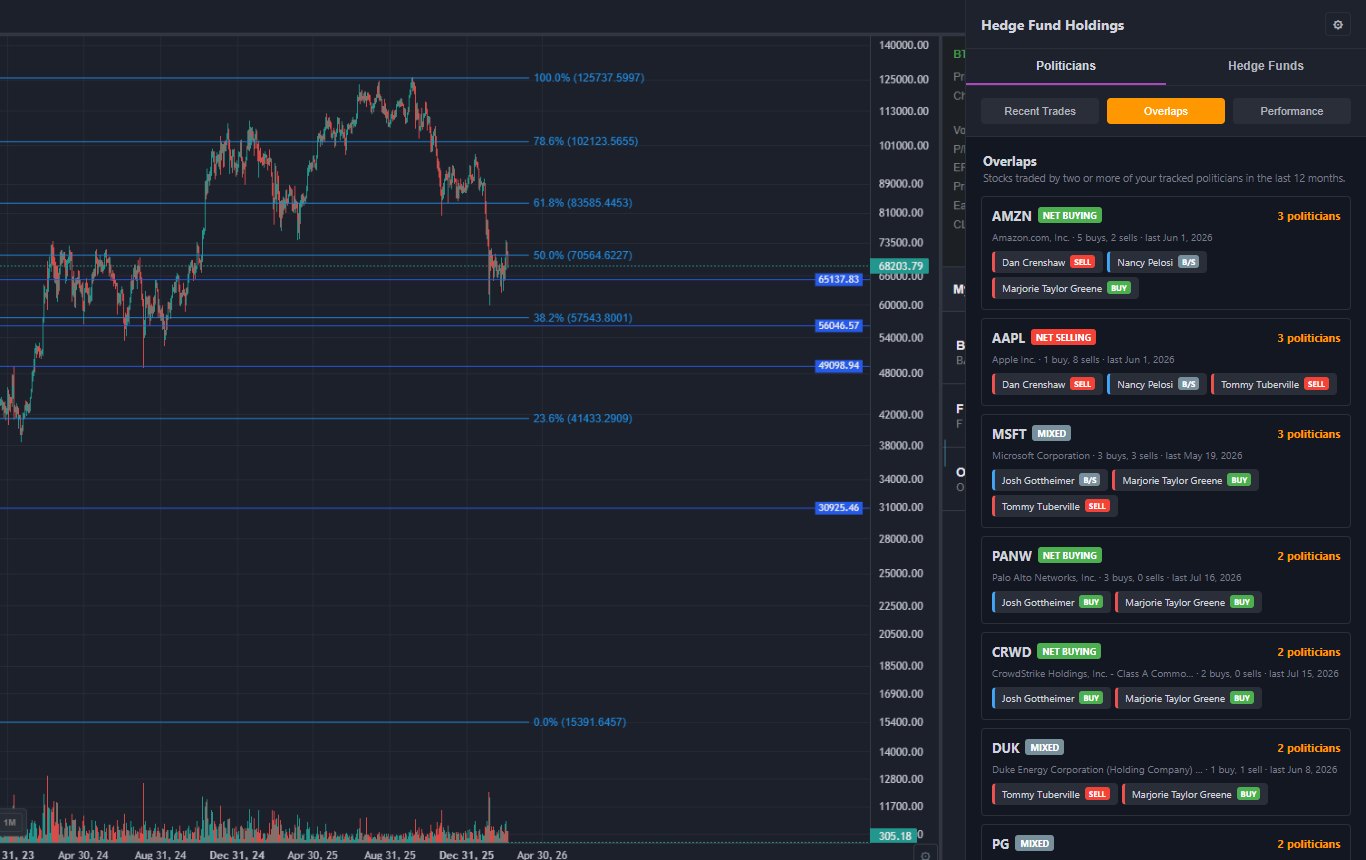
Overlaps view, August 2026: stocks that two or more tracked politicians traded in the last 12 months.
- 180+ members with disclosed trades — Pelosi, Tuberville, Crenshaw, Gottheimer, Greene, Rick Scott and the rest of the most-followed names flagged Popular, everyone else searchable by name or state
- Every trade decoded — ticker, BUY / SELL / PARTIAL SELL, the disclosed size range, trade and filing dates, and whether the account belongs to the member, a spouse, a joint account or a dependent
- Recent Trades, Overlaps and Performance — a 45-day feed across your tracked members, stocks several of them traded at once, and the return since each disclosed buy versus the S&P 500 over the same windows
- Same panel as insiders and 13F — check a politician's buy against what the company's own executives and the big funds are doing in a couple of clicks
Insiders First, Politicians Second
An executive buying with their own money is filed within two business days and carries a confidence score built from their track record. A politician's trade arrives up to 45 days later as a dollar range. When both point the same way on the same stock, that is the confluence worth acting on. Our guide on tracking politician stock trades covers the sources, the ranges and the lag in detail.
How to Use Insider Data in Your Workflow
- 1. Start with the Purchases tab. Open the insider panel on any stock you are researching and check who has been buying with their own money. Routine grants, vestings, and tax transactions are already filtered out, so every entry you see is a deliberate trade.
- 2. Check the insider's confidence score. Before acting on any filing, look at the color-coded badge and open the performance popup. An insider with a high confidence score and a strong realized win rate buying again is far more compelling than a first-time buyer with no track record.
- 3. Cross-reference with the chart. Pull up the stock's chart and check the technical setup. Insider buying near a support level or after a pullback to a key moving average is a much stronger setup than buying into an extended rally.
- 4. Check the CL Score. Combine insider activity with ChartingLens's proprietary technical rating. Insider buying plus a high CL Score is a powerful confluence of fundamental and technical bullishness.
- 5. Set alerts. If the price is not at your desired entry, set a price alert and wait for the stock to come to you. Insider data gives you the conviction; the alert system gives you the discipline.
- 6. Check the Politicians and Hedge Funds tabs. Flip to the Politicians tab to see whether any member of Congress disclosed the same stock, and to the hedge fund side for 13F holders. Insider buying corroborated by politicians and funds is the strongest smart-money confluence the panel can show.
Recommended Reading
Check out our blog guide on how to interpret insider trading data for a deeper walkthrough of building an insider-based trading strategy, including real examples of high-conviction insider buys that preceded major stock moves.
Free vs Premium vs Pro
Insider trading data is free for every ChartingLens account. Nothing on this page sits behind a paywall — the same real-time filings, confidence scores, and performance breakdowns are available on Free ($0), Premium ($14.99/mo), and Pro ($29.99/mo).
| Feature | Free ($0) | Premium ($14.99/mo) | Pro ($29.99/mo) |
|---|---|---|---|
| Real-time Form 4 filings (2-year lookback) | Free | Free | Free |
| Insider confidence scores (0-100) | Free | Free | Free |
| Insider performance popup & P&L breakdown | Free | Free | Free |
| Transaction type & role filters | Free | Free | Free |
| New-filing notifications via daily digest | Free | Free | Free |
| Politician trades (Congress disclosures) with performance & overlaps | Locked preview | Included | Included |
Track what insiders are buying
See real-time SEC filings and insider confidence scores today — free on every account.
Create Free Account View All Features