Options trading is fundamentally different from buying and selling stocks. When you trade a stock, your analysis centers on one variable: price direction. With options, you are managing a multi-dimensional puzzle involving price, time, volatility, and probability. A stock chart can tell you where a ticker is heading, but it cannot tell you which strike price to choose, how much time decay will eat into your position overnight, or whether implied volatility is inflated relative to historical norms. That is why options traders need specialized tools that go far beyond basic charting.
The right options trading tools can mean the difference between a profitable strategy and an expensive lesson. Sound risk management is the foundation of any options strategy, and the right tools make that discipline easier to enforce. An options profit calculator lets you model your maximum gain, maximum loss, and breakeven points before you commit a single dollar. An options scanner helps you filter through thousands of contracts to find setups that match your criteria, whether that is high volume, low implied volatility rank, or unusual open interest. And tools that track unusual options activity can reveal where institutional money is flowing before the rest of the market catches on.
In this guide, we break down the best options trading platforms, scanners, calculators, and analysis tools available in 2026. We cover everything from the best options trading platform for beginners to advanced options flow scanners used by professional traders. Whether you are selling covered calls for income, trading 0DTE options for fast profits, or building iron condor strategies for consistent returns, you will find the right tools here.
What to Look for in Options Trading Tools
Not all options platforms are created equal. Before committing to a tool, evaluate it against these six criteria that matter most for serious options trading.
Real-Time Options Chain
Can you view live bid/ask spreads, volume, open interest, and implied volatility across all strikes and expirations?
Profit/Loss Calculator
Does the platform let you model P/L diagrams for single-leg and multi-leg strategies before you enter a trade?
Options Scanner
Can you screen for contracts by volume, OI, IV rank, Greeks, or custom criteria to find opportunities fast?
Greeks Display
Does the chain show Delta, Gamma, Theta, and Vega for every contract so you can assess risk at a glance?
Unusual Activity Alerts
Does the platform flag outsized trades, sweeps, or unusual volume that may signal institutional positioning?
Strategy Builder
Can you construct multi-leg strategies (spreads, condors, straddles) with a visual interface and see combined Greeks?
The best options trading platform for you depends on which of these features your strategy demands. A covered call seller may only need a solid options chain and a basic calculator. A day trader scalping 0DTE SPX contracts needs real-time data, lightning-fast execution, and Greeks that update tick by tick. And a swing trader scanning for unusual options flow needs robust screening and alert tools. Keep these criteria in mind as we walk through each platform below.
Quick Comparison Table
Here is how the top options trading platforms and tools compare across the features that matter most to options traders.
Scroll horizontally to see all columns →
Feature
Thinkorswim
Unusual Whales
ChartingLens
tastytrade
IBKR
Webull
Robinhood
TradingView
Options Chain
Advanced
Full
✗
Advanced
Advanced
Basic
Basic
Limited
P/L Calculator
✓
✓
✗
✓
✓
Basic
Basic
✗
Options Scanner
✓
✓
✗
✓
✓
✗
✗
Via scripts
Greeks Display
Full
Full
✗
Full
Full
✓
Delta only
✗
Unusual Activity
✓
Real-time
Options flow
✓
Limited
✗
✗
✗
Strategy Builder
✓
✓
✗
✓
✓
Basic
Basic
✗
AI Chart Analysis
✗
AI analyst
✓
✗
✗
✗
✗
✗
AI Buy/Sell Signals
✗
✗
✓
✗
✗
✗
✗
✗
Technical Indicators
100+
✓
40+
~20
100+
~10
~5
100+
Price
Free (Schwab)
Free / $50+/mo
Free / $14.99/mo
Free
Free + data fees
Free
Free
Free / $14.95+/mo
Best Options Trading Platforms (In-Depth Reviews)
We tested each of these platforms with a focus on their options-specific features. Here are our in-depth reviews, ranked by overall value to options traders.
#1. Thinkorswim (Schwab) — Best Overall for Options Trading
Thinkorswim (Schwab)Free with Schwab Account
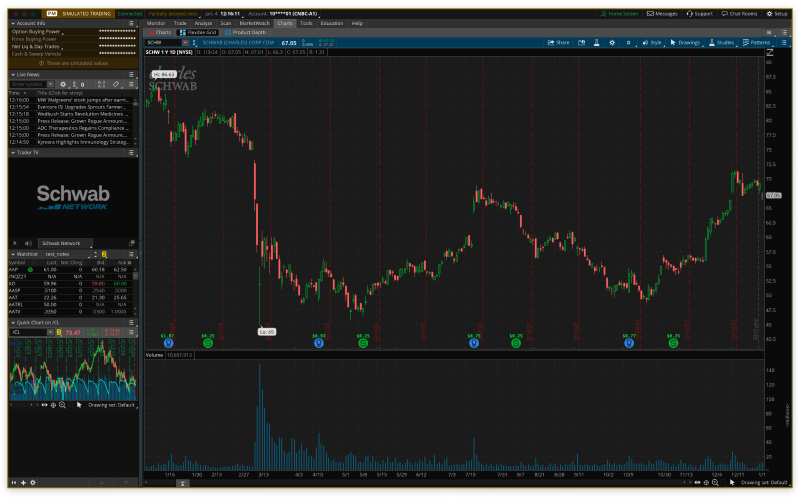
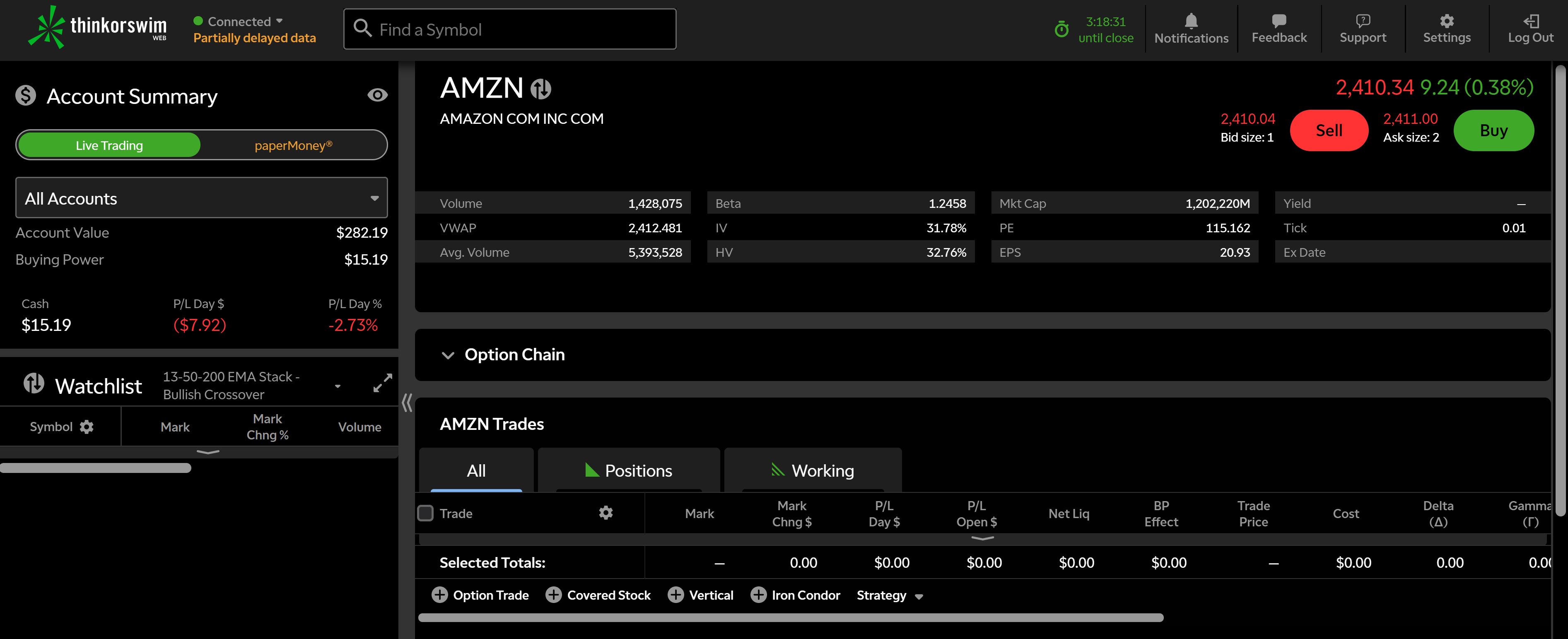
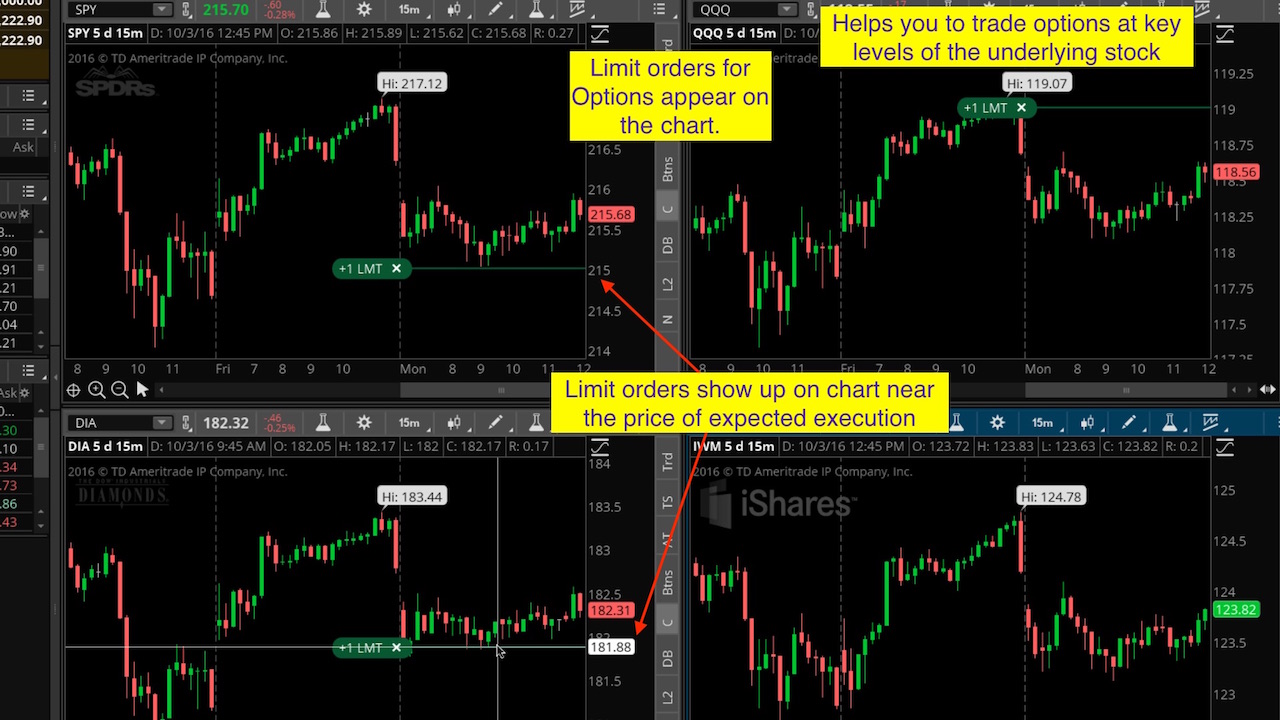
Thinkorswim is the gold standard for options trading platforms and the top choice for serious options traders. Originally built by TD Ameritrade and now part of Charles Schwab, it offers the deepest set of options analysis tools available on any free platform. The options chain is fully customizable: you can display any combination of Greeks, implied volatility, probability of profit, and theoretical values alongside the standard bid/ask and volume data.
The Analyze tab is where Thinkorswim truly shines for options. It includes a built-in options profit calculator that lets you model any strategy, from a simple long call to a complex iron condor, and visualize your P/L across different prices, dates, and volatility scenarios. The probability analysis tool shows you the statistical likelihood of your trade finishing in the money, which is invaluable for strategies like the options wheel strategy or credit spreads.
Thinkorswim also includes a powerful options scanner (the Option Hacker tool) where you can filter contracts by volume, open interest, implied volatility, and dozens of other criteria. The thinkScript programming language lets advanced users build custom scans, indicators, and alerts. Paper trading with real-time data is included, making it an excellent learning environment for new options traders.
Pros
Most comprehensive options analysis suite available for free
Built-in P/L calculator with probability analysis
Advanced options scanner with custom thinkScript filters
Full Greeks display and risk graphs
Paper trading with live data
Unusual activity scanning
Cons
Requires a Charles Schwab brokerage account
Steep learning curve for new traders
Desktop app can feel dated and resource-heavy
No AI-powered chart analysis or signals
Best for: Serious options traders who want the most powerful free options analysis platform. The undisputed #1 for options chain analysis, probability tools, and strategy modeling.
Unusual Whales is the dedicated options flow scanner on this list, and it is the tool to reach for when you want to see where large, aggressive money is moving in real time. Instead of an options chain built for placing orders, its real-time flow feed covers the entire U.S. options market, from single-contract fills to 10,000-contract orders, tagged as sweeps, blocks, or splits, with the premium, strike, expiration, and whether the order filled at the bid or the ask. Filters let you narrow the firehose down to what matters for your strategy: bid or ask side, calls or puts, premium, size, volume, percentage out of the money, and the Greeks.
It is not just a flow feed, either. Every ticker has a full options chain with quotes, volume, open interest, implied volatility, and the Greeks (Delta, Gamma, Theta, Vega) on every strike, plus Greeks and volatility dashboards, a GEX heatmap for all U.S. tickers, and market maker exposure for SPX that shows where dealer hedging may pin or accelerate price. The built-in options profit calculator models 28 ready-made strategies, from single calls and puts to spreads, condors, and straddles, and plots the P/L and Greeks of the whole position before you commit.
Around that core, Unusual Whales adds dark pool data, stock charts with technical indicators, a congressional trading tracker built from politicians' disclosed trades, insider and institutional holdings data, and Mr. Whale, an AI analyst. Alerts show up on the website, in the iOS and Android apps with push notifications, and through a Discord bot, so you do not have to stare at the feed all day to catch unusual options activity on the tickers you care about.
Like any flow tool, Unusual Whales tells you what other traders are doing, not what you should do. A large call sweep can be a hedge, a roll, or one leg of a spread, so the data works best as the starting point for your own analysis. It is not a broker, so you will still execute through Thinkorswim, tastytrade, or another options platform, and the sheer density of data takes some time to learn. The free plan includes the dashboard, screeners, and charts, but options flow on it runs 15 minutes behind; real-time flow starts with the Retail Basic plan at $50/month, or $42/month billed yearly. Pair it with a charting tool to check the underlying's trend and key levels before acting on a flow alert.
Pros
Real-time options flow covering the whole U.S. market, tagged as sweeps, blocks, and splits
Flow filters for side, premium, size, volume, % out of the money, and Greeks
Full options chains with Delta, Gamma, Theta, Vega, and IV on every strike
GEX heatmaps, market maker exposure, and Greeks and volatility dashboards
Options profit calculator with 28 built-in strategies
Dark pool data and a congressional trading tracker
Alerts on web, iOS and Android (push), and Discord
Free plan available
Cons
Free plan's options flow is delayed 15 minutes; real-time starts at $50/mo
Not a broker (no order execution)
Data-dense interface has a learning curve
Flow can reflect hedges rather than directional bets
Best for: Options traders who follow smart money and want a real-time, filterable feed of unusual options activity, dark pool prints, and congressional trades.
#3. ChartingLens — Best AI Charting Companion with Options Flow Context
ChartingLensFree + $14.99/mo Premium
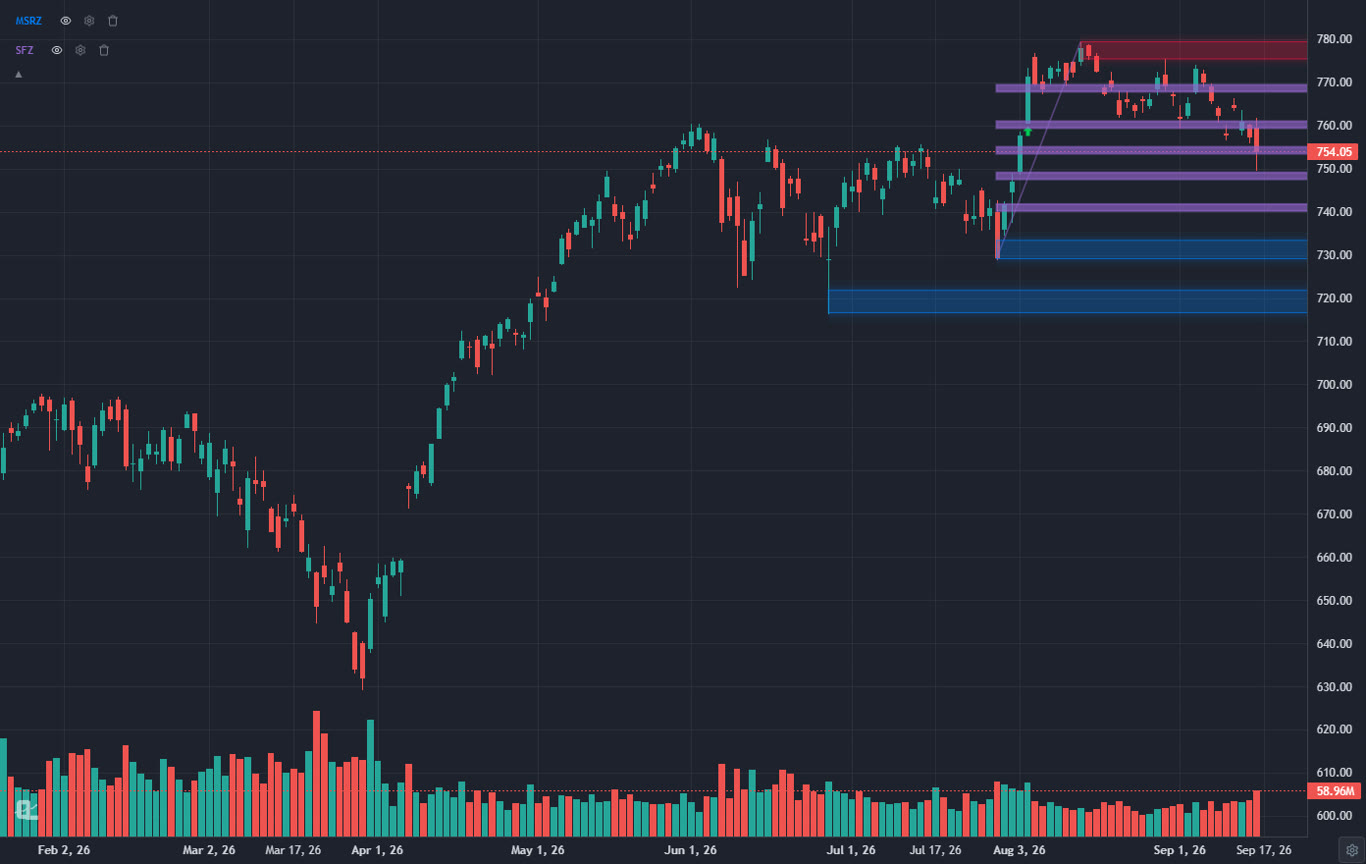
Let's be honest about what ChartingLens is and is not. It is not a dedicated options trading platform: there are no tradeable options chains, no Greeks scanner, and no order execution, so you will still place your actual options trades through Thinkorswim, tastytrade, or your broker of choice. What this well-established charting platform does, and what its large active user base of options traders relies on it for, is everything that happens before the order ticket: reading the underlying, checking where options positioning is concentrated, and timing the entry. For options traders, timing your entry on the underlying is often the single biggest factor determining whether your trade is profitable.
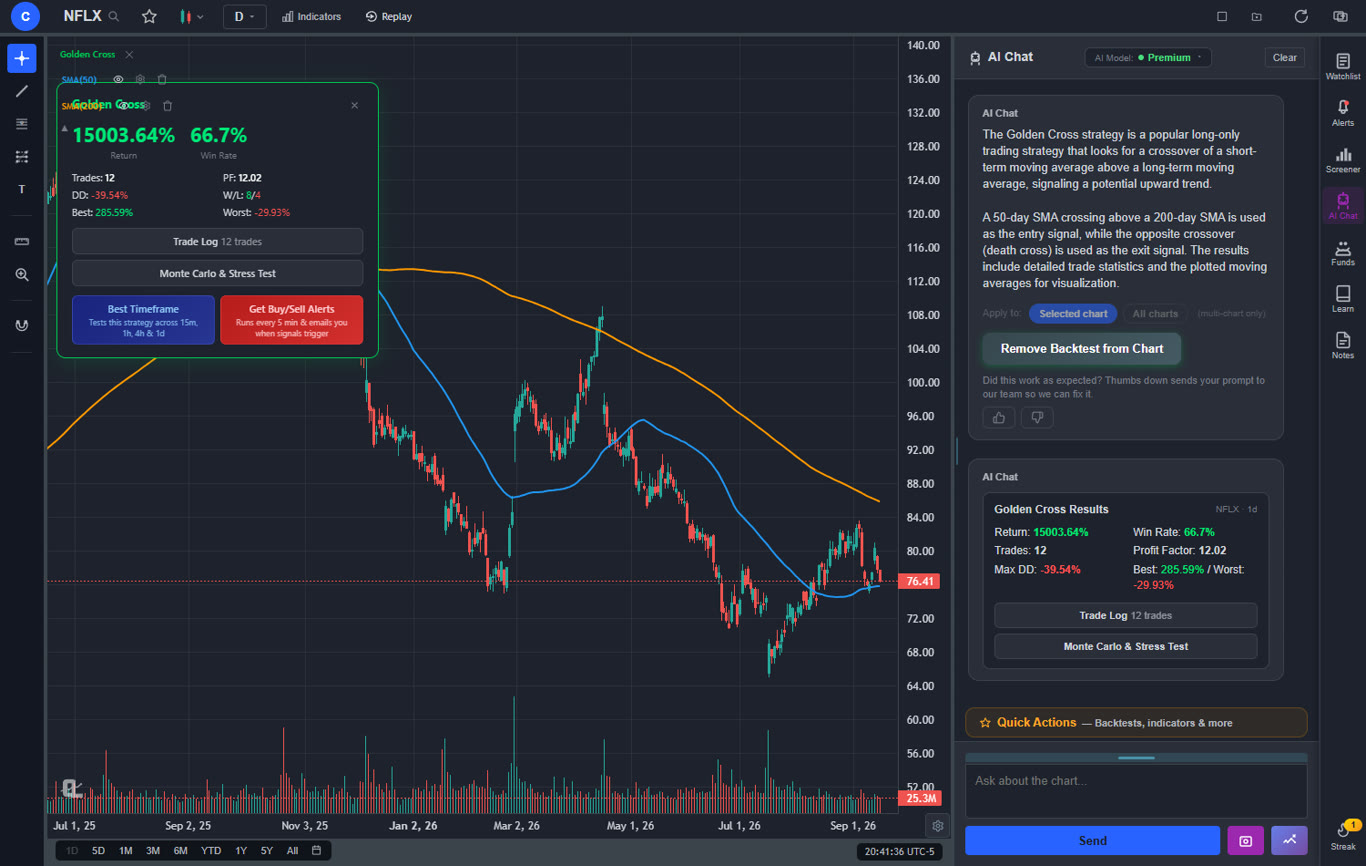
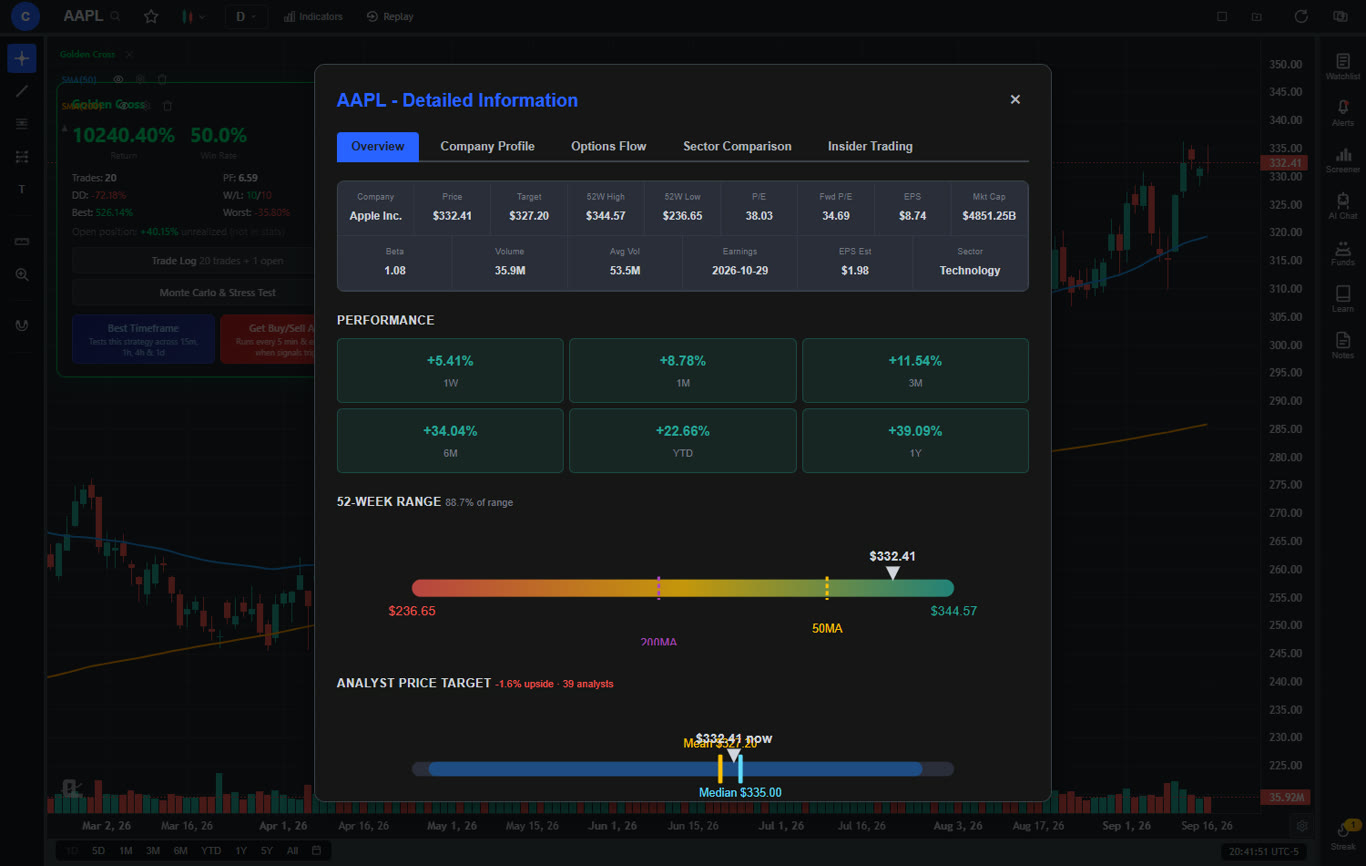
Start with the Options Flow tab inside the stock information panel, which breaks down a ticker's options activity by expiration, strike, and put/call ratio, so you can see at a glance where positioning is stacking up before you choose your own strike. Then check the AI buy/sell signals, which scan over 2,000 stocks for high-probability technical setups, and layer on the 40+ free technical indicators (RSI, MACD, Bollinger Bands, EMA, and more) to confirm the bias. When a stock gaps on you mid-trade, the AI Chat answers "why did AAPL move today?" with real news context and gives you a verdict-first read on the underlying instead of a wall of hedging. You can also check the insider trading data to see if executives are buying or selling before you commit premium.
For finding candidates in the first place, the stock screener includes the momentum filters options traders actually use: relative volume (RVOL), gap percentage, and unusual current-day volume. And before you spend premium on a directional thesis, the institutional-grade strategy builder and institutional-grade backtesting engine let you validate that thesis on the underlying's historical data first. Pricing is a fraction of what dedicated flow scanners charge: the free plan is $0 forever with no credit card required, Premium is $14.99/month, and Pro is $29.99/month (yearly billing saves 17%), compared to $50/month and up for real-time plans on dedicated flow tools like Unusual Whales.
Pros
Options Flow tab: activity by expiration, strike, and put/call ratio
AI buy/sell signals help time options entries on the underlying
a large technical indicator library on the free tier
Screener with RVOL, Gap %, and unusual-volume momentum filters
Institutional-grade strategy builder and backtesting engine
AI Chat explains news moves with verdict-first analysis
Free plan is $0 forever; Premium just $14.99/mo
Converts pasted Pine Script and thinkScript studies into native indicators (Premium) - useful if your custom studies live in thinkorswim today, though studies built on options or open-interest data will not convert
Stocks, ETFs, crypto, forex, metals, and index and commodity CFDs (US30, US500, NAS100, oil, gold) in one search bar
25 daily AI buy signals with a public, forward-tested track record and a trade plan (entry, stop, target) on every signal
Backtests include a Monte Carlo stress test and intrabar exits, built from a plain-English strategy description
Free interactive courses drawn on real charts, plus a notes and journal panel
Cons
Not an options trading platform (no chains, Greeks, or execution)
Must be used alongside a separate options broker
Options flow is per-ticker context, not a real-time sweep/block feed
Best for: Options traders who want options-flow context, AI-powered technical analysis, and smart money data to time their entries on the underlying stock. Use alongside your options broker for the best results.
Free plan is free forever — no credit card required.
#4. tastytrade — Best Options-First Platform
tastytradeFree
tastytrade (formerly tastyworks) was built from the ground up as an options-first trading platform. Founded by Tom Sosnoff, one of the creators of Thinkorswim, tastytrade strips away the complexity and focuses on what options traders actually need: fast trade entry, clear probability metrics, and a workflow designed for selling premium. The platform defaults to showing options chains rather than stock charts, which reflects its philosophy that options trading should be the primary activity, not an afterthought.
One of tastytrade's standout features is the "Follow" functionality, where you can see and replicate trades made by experienced traders and the tastytrade research team. The platform also excels at displaying options Greeks explained in practical terms: each contract shows Delta, Theta, and IV rank in a clean layout that helps you assess risk instantly. The trade ticket makes it easy to build multi-leg strategies with just a few clicks, whether you are constructing a vertical spread, an iron condor strategy, or a strangle.
tastytrade also includes a built-in options flow viewer and unusual activity alerts through its connection with the tastylive media network. The educational content is exceptional: tastylive produces hours of daily programming that covers options mechanics, strategy breakdowns, and live trade reviews. Commissions are competitive at $1 per contract with a $10 cap per leg.
Pros
Designed specifically for options traders
Follow trades from experienced traders
Excellent probability and IV rank tools
Fast multi-leg trade entry
World-class options education via tastylive
$1/contract commissions with $10 cap per leg
Cons
Charting tools are basic compared to Thinkorswim
Limited stock research and fundamental data
Platform design may feel unfamiliar to stock-first traders
No AI chart analysis
Best for: Premium sellers and probability-focused options traders who want a platform built for their workflow from the start.
#5. Interactive Brokers — Best for Professional Options Traders
Interactive Brokers (IBKR)Free + Optional Data Fees
Interactive Brokers is the platform of choice for professional and institutional options traders. IBKR's Trader Workstation (TWS) offers the most granular options analysis tools of any retail broker: the Risk Navigator provides portfolio-level Greeks, stress testing, and Value at Risk (VaR) calculations. The Options Strategy Lab lets you scan for strategies that match your outlook (bullish, bearish, neutral) and rank them by potential return, probability of profit, or risk/reward ratio.
IBKR's options screener is among the most powerful available. You can filter contracts across the entire U.S. options market by dozens of criteria including IV rank, volume/OI ratio, days to expiration, Delta range, and sector. The Volatility Lab shows you implied versus historical volatility charts, term structure, and volatility skew for any underlying, which is critical for strategies that depend on mean-reverting volatility like iron condors and strangles.
The downside of IBKR is complexity. The platform was built for professionals, and it shows. The interface is dense and can be overwhelming for beginners. Some real-time data feeds require additional subscriptions ($1.50 to $10 per month depending on the exchange). However, if you are trading options seriously and want the lowest commissions ($0.65 per contract, lower with volume), the broadest market access (options on global exchanges), and institutional-grade risk tools, Interactive Brokers is hard to beat.
Pros
Institutional-grade Risk Navigator and Volatility Lab
Most powerful options screener among retail brokers
Lowest commissions for active traders ($0.65/contract)
Global market access for options
Options Strategy Lab for trade idea generation
Cons
Very steep learning curve
Interface can feel dated and overwhelming
Some data feeds require paid subscriptions
Not beginner-friendly at all
Best for: Professional options traders who need institutional-grade risk management, the lowest commissions, and global market access.
#6. Webull — Best Free Options Trading on Mobile
WebullFree
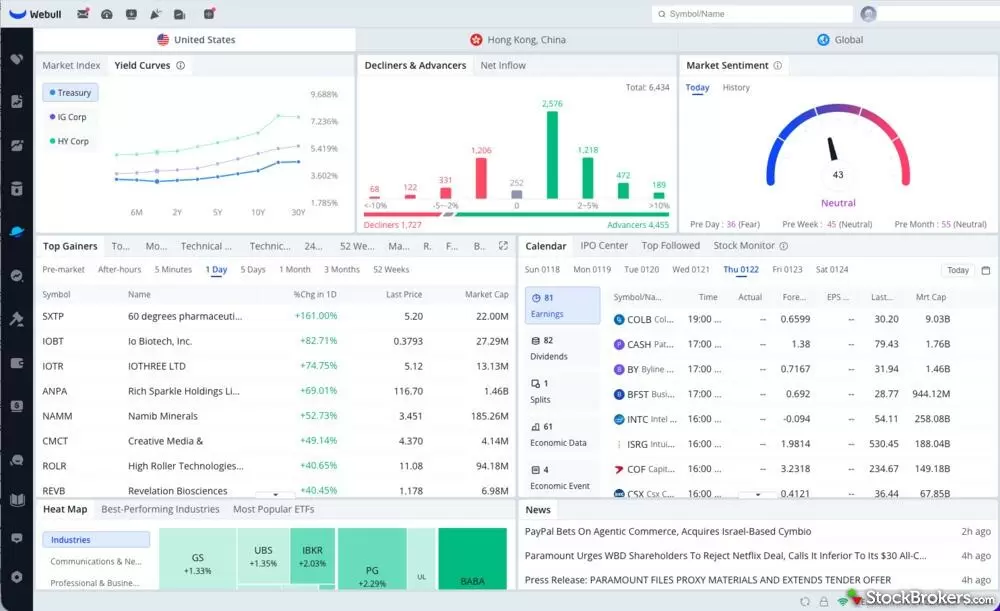
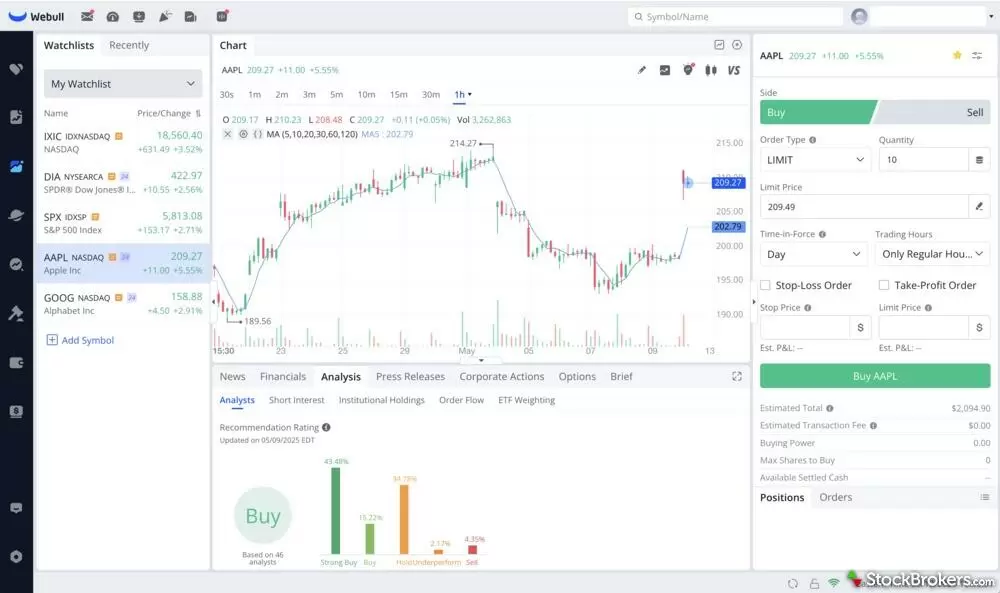
Webull offers commission-free options trading with a clean, modern interface that works well on both mobile and desktop. The options chain is straightforward: you can view calls and puts side by side, see basic Greeks (Delta, Gamma, Theta, Vega), and place orders with a few taps. For traders who want to dip their toes into options trading without paying commissions or dealing with a complicated platform, Webull delivers a smooth experience.
The platform includes basic strategy templates for common trades like vertical spreads, straddles, and strangles. You can view a simple P/L chart before submitting a trade, though it lacks the depth of Thinkorswim's Analyze tab. Webull also provides paper trading so you can practice options strategies with virtual money before risking real capital.
Where Webull falls short for options is in the advanced tools category. There is no dedicated options scanner, no unusual activity alerts, no IV rank visualization, and no way to build complex strategies beyond the basic templates. The charting tools are basic, with a limited number of indicators. If you are trading simple calls, puts, or basic spreads on a few tickers, Webull is perfectly adequate. But if your strategy requires deeper analysis, you will need to supplement it with other tools.
Pros
Commission-free options trading
Clean, modern mobile and desktop interface
Basic Greeks display on options chain
Paper trading available
Easy for beginners to navigate
Cons
No options scanner or screener
No unusual activity alerts
Limited strategy building tools
Basic charting with few indicators
Best for: Beginners and casual options traders who want commission-free trading with a simple, intuitive interface.
#7. Robinhood — Simplest Options Trading for Beginners
RobinhoodFree
Robinhood brought options trading to the mainstream by making it commission-free and ridiculously simple. The options interface strips away nearly all complexity: you see a clean list of strikes, a basic P/L chart showing your max gain and max loss, and a big button to submit the trade. For complete beginners who want to buy their first call option without being overwhelmed by Greeks and probability curves, Robinhood removes the intimidation factor.
However, that simplicity comes at a significant cost. Robinhood shows only Delta in its options chain, hiding the other Greeks that experienced traders rely on. There is no options screener, no strategy builder for multi-leg trades beyond basic spreads, and no unusual activity data. The charting tools are minimal, with only a handful of indicators available. Robinhood has also faced criticism for its options order routing practices and the quality of fills traders receive.
Robinhood Gold ($5/month) adds some features like deeper market data and research reports, but it does not meaningfully improve the options toolset. If you are just starting with options and want to learn the basics of buying calls and puts, Robinhood's simplicity can be helpful. But you will outgrow it quickly once you move beyond single-leg trades.
Pros
Commission-free options trading
Extremely simple, beginner-friendly interface
Easy to understand P/L visualization
Low barrier to entry
Cons
Only shows Delta, not other Greeks
No options scanner or unusual activity
Very limited strategy building
Minimal charting tools
Order fill quality concerns
Best for: Absolute beginners buying their first options who want the simplest possible interface with zero commissions.
#8. TradingView — Best for Charting Options Setups
TradingViewFree (limited) + from $14.95/mo
TradingView is primarily a charting platform, not an options trading tool. However, many options traders use it for charting the underlying stock before placing trades on their broker. TradingView offers an extensive library of technical indicators, Pine Script for custom indicator development, and a large social community where traders share chart analyses and trade ideas.
TradingView does have a basic options chain view on some paid tiers, but it is minimal compared to dedicated options platforms. There is no strategy builder, no P/L calculator, and no options flow scanner. The free tier is also quite restrictive: you can only use one indicator per chart and you see ads throughout the platform. Paid plans start at $14.95 per month.
For options traders who need advanced charting capabilities, such as custom indicators built in Pine Script, multi-timeframe analysis, or point-and-figure charts, TradingView fills that role. But you will still need a separate options platform for the actual options analysis and execution. If you are looking for an alternative charting tool that includes AI signals and insider data at a lower price point, ChartingLens offers more out of the box on its free tier.
No strategy builder, P/L calculator, or flow scanner
Free tier limited to 1 indicator and shows ads
Paid plans more expensive than alternatives
Best for: Options traders who need advanced charting and Pine Script for custom technical analysis of the underlying.
Options Profit Calculator
An options profit calculator is one of the most important tools in any options trader's arsenal. Before you enter a trade, you need to know your maximum gain, maximum loss, breakeven price, and how your position's value changes as the underlying moves and time passes. Without modeling these scenarios upfront, you are essentially trading blind.
What an Options Profit Calculator Does
An options profit calculator takes your trade parameters (strike price, premium paid or received, expiration date, and number of contracts) and generates a P/L diagram. This diagram shows you exactly how much you stand to make or lose at every possible price of the underlying stock at expiration. For multi-leg strategies like spreads, iron condors, and straddles, the calculator combines all legs into a single P/L curve, revealing the trade's risk/reward profile at a glance.
More advanced calculators also model the time dimension. They show you how your position's value evolves day by day as theta decay erodes extrinsic value. This is critical for strategies like selling credit spreads, where time is working in your favor, or buying long options, where time works against you.
Best Options Profit Calculator Tools
OptionsProfitCalculator.com — The most popular free online calculator. Supports all standard strategies, shows P/L at expiration and at earlier dates, and integrates real-time option pricing. No account required.
OptionStrat — A premium calculator with an outstanding visual interface. Shows profit zones as color-coded heat maps, updates in real time, and supports complex multi-leg strategies. The free tier is limited; paid plans start at $24.99/month.
Thinkorswim Analyze Tab — Built directly into the Thinkorswim platform. Model any strategy, adjust volatility assumptions, and see how your position changes across price and time. Free with a Schwab account.
tastytrade Curve Analysis — Integrated into the tastytrade platform. Displays P/L curves with probability overlays so you can see both the expected value and the risk range. Free with a tastytrade account.
The best approach is to always model your trade before placing it. Spending 30 seconds in an options profit calculator can save you from trades where the risk/reward is unfavorable, or where your breakeven price is further away than you assumed.
Options Scanner & Screener
An options scanner (also called an options screener) lets you filter through thousands of options contracts to find the ones that match your specific criteria. Instead of manually scrolling through options chains ticker by ticker, a scanner automates the search and delivers a curated list of opportunities.
What to Scan For
The most common filters used by options traders include:
Volume and Open Interest — High volume and open interest indicate liquid contracts where you can get in and out without wide bid/ask spreads. A common rule of thumb is to look for contracts with at least 100 open interest and daily volume above 50.
Implied Volatility Rank (IV Rank) — IV Rank tells you where current implied volatility sits relative to its range over the past year. A high IV Rank (above 50) means premiums are elevated, which favors selling strategies. A low IV Rank favors buying strategies.
Days to Expiration (DTE) — Filter by expiration to find contracts in your preferred time frame. Premium sellers often target 30-45 DTE for optimal theta decay. Traders looking at 0DTE options filter for same-day expirations.
Delta Range — Scan for contracts within a specific Delta range. For example, a covered call screener might look for calls with Delta between 0.25 and 0.35 to find strikes with a good balance between premium income and probability of being called away.
Earnings Date Filter — Some scanners let you exclude stocks with upcoming earnings to avoid binary events, or specifically target them if you are trading earnings volatility.
Best Options Scanners and Screeners
Thinkorswim Option Hacker — The most customizable free options screener. Build scans using any combination of price, volume, Greeks, IV, and technical criteria. Save and reuse custom scans. Free with Schwab.
IBKR Option Scanner — Institutional-grade filtering across the entire U.S. options market. Includes pre-built scans for high IV, unusual volume, and upcoming earnings plays.
Barchart Options Screener — A solid web-based options scanner that lets you filter by volume, OI, IV percentile, and strategy type (covered calls, cash-secured puts, etc.). The free tier offers basic scans; premium unlocks more filters.
Market Chameleon — Specializes in volatility analysis. Their scanner excels at finding stocks where IV is historically elevated or depressed, ideal for mean-reversion volatility strategies.
tastytrade Watchlist Scanner — Filters your watchlist by IV rank, liquidity, and sector. Built for premium sellers who want to find the most efficient trades quickly.
For the best results, combine an options screener with technical analysis of the underlying stock. Use your scanner to identify high-probability options setups, then confirm the directional bias using charting tools like ChartingLens with its AI buy/sell signals and 40+ free indicators.
Unusual Options Activity
Unusual options activity is one of the most followed signals in the trading world. When a single options trade is significantly larger than the average daily volume for that contract, it suggests that someone with deep pockets, often an institutional investor or a well-informed trader, is making a directional bet. Following these large trades, sometimes called "smart money" or "whale" trades, can provide valuable insight into where informed capital expects a stock to move.
How to Spot Smart Money in Options Flow
Tracking options flow involves watching for several key signals:
Sweeps — When a large order is broken into smaller pieces and executed across multiple exchanges simultaneously to fill quickly. Sweeps indicate urgency, which often means the buyer is acting on time-sensitive information.
Block Trades — Single trades of 100+ contracts executed at once, often at or above the ask price. Buying at the ask (rather than bidding) signals conviction.
Volume/OI Ratio — When daily volume far exceeds open interest for a specific strike, it means new positions are being established rather than existing ones being closed. A volume/OI ratio above 3 is generally considered unusual.
Dark Pool Prints — Large trades executed off-exchange through dark pools sometimes precede significant moves. While dark pool data is harder to access, some flow tools report these prints.
Repeat Sweeps — When the same strike and expiration see multiple sweeps throughout the day, it suggests sustained institutional interest rather than a one-off trade.
Best Unusual Options Activity Tools
Unusual Whales — One of the most popular options flow scanners with a clean interface and real-time alerts. Shows sweeps, blocks, and dark pool activity. Congress trading tracker included. Free plan with delayed flow; real-time plans from $50/month.
Cheddar Flow — Real-time options flow with smart filtering. Highlights the most significant trades and lets you filter by ticker, expiration, and trade type. From $49/month.
FlowAlgo — Professional-grade options flow and dark pool analysis. Shows real-time flow with historical data for backtesting. From $29/month.
Thinkorswim Sizzle Index — Free unusual activity indicator built into Thinkorswim. The "Sizzle Index" compares today's options volume to the 5-day average. A Sizzle above 2.0 indicates unusual activity.
tastytrade Follow Feed — Shows real-time unusual activity and large trades within the tastytrade ecosystem. Free with a tastytrade account.
A word of caution: unusual options activity does not guarantee a profitable trade. Large trades can be hedges against existing positions, portfolio adjustments, or even poorly timed bets by institutional traders who get it wrong. Use unusual activity as one data point alongside your own technical and fundamental analysis, not as a standalone trading signal.
And if you need per-ticker context rather than a firehose of real-time sweeps, the Options Flow tab on ChartingLens shows a stock's options activity broken down by expiration, strike, and put/call ratio right next to the chart, so you can sanity-check positioning on the underlying without paying for a separate flow subscription.
0DTE Options (Zero Days to Expiration)
0DTE options, short for zero days to expiration, are options contracts that expire on the same trading day. They have gone from a niche curiosity to one of the most traded segments of the options market, with 0DTE contracts now accounting for over 40% of total SPX options volume on many trading days. The introduction of daily expirations on major indices (SPX, SPY, QQQ, IWM) fueled this explosion, giving traders the ability to trade same-day options every day of the week.
Why 0DTE Options Exploded in Popularity
Several factors drove the surge in zero days to expiration trading:
Extreme Gamma Sensitivity — With no time left, 0DTE options respond dramatically to small price moves in the underlying. A one-point move in SPX can cause a 0DTE option to double or triple in value, creating opportunities for outsized percentage gains.
Low Absolute Cost — Because there is minimal time value remaining, 0DTE options are often priced at just a few dollars per contract. This low absolute cost attracts traders who want to risk small amounts for potentially large payoffs.
Daily Expirations — Before daily expirations, you could only trade 0DTE options on the specific days when weekly or monthly options expired. Now, with daily expirations available on SPX, SPY, and other major products, every trading day is a 0DTE day.
No Overnight Risk — Positions expire at the end of the day, eliminating the risk of overnight gaps, after-hours earnings surprises, or weekend news events affecting your trade.
Risks of 0DTE Options
While the potential rewards are appealing, 0DTE options carry significant risks that every trader should understand:
Rapid Theta Decay — Time value evaporates throughout the day. If the underlying does not move in your favor quickly, your option can lose most of its value even if the stock is still near your strike.
Amplified Losses for Sellers — Selling 0DTE options exposes you to the same gamma risk that benefits buyers. A sudden, sharp move can turn a small premium income into a massive loss in minutes.
Whipsaw Risk — Intraday volatility can trigger stop losses and cause rapid swings in P/L. A position that is profitable at 11 AM can be deep in the red by noon and back to breakeven by 2 PM.
Assignment and Pin Risk — For options that expire near the money, there is a risk of unexpected assignment, especially in the final minutes of trading.
Strategies for 0DTE Options
Common strategies for trading zero days to expiration include selling iron condors on SPX at the open to collect premium from theta decay, buying directional options ahead of key economic data releases or Fed announcements, and scalping quick moves using tight stop losses. Regardless of strategy, proper position sizing is critical. Many experienced 0DTE traders risk no more than 1-2% of their account on any single trade.
For 0DTE traders, strong technical analysis of the underlying is essential. Tools like ChartingLens can help you identify key support and resistance levels, trend direction, and momentum shifts using AI-powered analysis, so you can choose your 0DTE strikes with more precision.
Options Greeks Explained
The options Greeks are a set of metrics that quantify how an option's price responds to changes in different market variables. Understanding the Greeks is fundamental to managing risk, choosing the right strikes, and evaluating whether a trade offers a favorable risk/reward profile. Here is what each Greek means in practical terms.
Delta
Delta measures how much an option's price changes for every $1 move in the underlying stock. A call option with a Delta of 0.50 will gain approximately $0.50 for each $1 the stock rises. Puts have negative Delta, meaning they gain value as the stock falls. Delta also serves as a rough estimate of the probability that an option will expire in the money: a Delta of 0.30 suggests roughly a 30% chance of finishing ITM.
Practical use: If you are selling covered calls and want a low probability of assignment, look for calls with Delta below 0.30. If you want a directional bet with strong exposure to the underlying's movement, choose options with Delta above 0.60.
Gamma
Gamma measures the rate at which Delta changes as the underlying stock moves. High Gamma means Delta will shift rapidly with small price changes. Gamma is highest for at-the-money options near expiration, which is exactly why 0DTE options are so volatile. A high-Gamma option can go from slightly profitable to deeply in the money (or out of the money) very quickly.
Practical use: Gamma risk is the primary concern for options sellers near expiration. If you are selling options, be especially cautious with high-Gamma positions because a sudden move can turn your trade against you rapidly. Buyers benefit from high Gamma when the stock moves in their favor.
Theta
Theta measures time decay: how much value an option loses per day, all else being equal. An option with Theta of -0.05 will lose $5 per contract per day just from the passage of time. Theta is the friend of options sellers and the enemy of options buyers. It accelerates as expiration approaches, which is why premium sellers often target options with 30-45 DTE to capture the steepest part of the decay curve.
Practical use: If you are running an income strategy like the options wheel strategy, selling covered calls, or writing cash-secured puts, positive Theta is your primary source of profit. If you are buying options, be aware that Theta erodes your position every day, so you need the underlying to move enough to offset the time decay.
Vega
Vega measures how much an option's price changes for a 1% change in implied volatility. An option with Vega of 0.10 will gain $10 per contract if IV increases by 1 percentage point. Vega is highest for at-the-money options with longer time to expiration. Strategies like iron condors and strangles are often entered when IV is high (and Vega is elevated) with the expectation that IV will contract, causing the sold options to lose value.
Practical use: Before selling premium, check IV Rank to see if implied volatility is historically elevated. If IV Rank is above 50, premiums are rich and a volatility contraction is more likely, which benefits short Vega positions like iron condor strategies and credit spreads.
Rho
Rho measures an option's sensitivity to changes in interest rates. A call option with Rho of 0.05 will gain $5 per contract if interest rates rise by 1%. Rho is the least-discussed Greek because interest rate changes are typically gradual and predictable. However, in environments where the Federal Reserve is actively raising or cutting rates, Rho can become a more meaningful factor, especially for LEAPS (long-term options) with over a year to expiration.
Practical use: For most short-term options strategies, you can safely ignore Rho. If you trade LEAPS or hold long-dated positions, be aware that rising interest rates slightly favor call buyers and slightly hurt put buyers.
Popular Options Strategies
Here is a brief overview of the most popular options strategies, each suited to different market conditions and risk tolerances.
Covered Calls (and Using a Covered Call Screener)
A covered call involves owning 100 shares of a stock and selling a call option against those shares. You collect the option premium as income, but in exchange, you cap your upside if the stock rises above the strike price. Covered calls are one of the most popular income strategies and are suitable for investors who are moderately bullish on a stock but want to generate additional yield.
A covered call screener helps you find the best stocks and strikes for this strategy. Screeners like the ones built into Thinkorswim, Barchart, and IBKR let you filter for stocks with high implied volatility (which means richer premiums), adequate liquidity, and strikes at your preferred Delta. Look for tickers with IV Rank above 30, strong support levels on the chart, and call options offering 1-3% monthly yield. Use a tool like ChartingLens to confirm the underlying stock's trend direction with AI signals before selecting your covered call strike.
The Options Wheel Strategy
The options wheel strategy cycles between two phases: selling cash-secured puts and selling covered calls. In phase one, you sell puts on a stock you want to own at a lower price. If the stock stays above your strike, you keep the premium and sell another put. If you get assigned, you now own the shares at a discount (strike price minus premium received). In phase two, you sell covered calls against those shares, collecting more premium. If your shares get called away, you start the cycle over again with phase one.
The wheel works best on high-quality, stable stocks that you would be comfortable owning for the long term. It generates income from the premiums collected on both legs, and the effective cost basis of your shares decreases with each completed cycle. Many wheel traders target stocks with moderate IV (enough to collect meaningful premium) and strong fundamentals.
Iron Condor Strategy
An iron condor strategy involves selling both a call spread and a put spread on the same underlying, creating a range within which you profit. You sell an out-of-the-money call and buy a further OTM call (the call spread), then sell an out-of-the-money put and buy a further OTM put (the put spread). Your maximum profit is the total premium collected, earned if the stock stays between your two short strikes at expiration.
Iron condors are a neutral strategy: you are betting that the stock will not move dramatically in either direction. They work best when implied volatility is elevated (so premiums are rich) and when you expect the underlying to trade in a range. The risk is that a large move in either direction can push the stock past one of your short strikes, resulting in a loss. Many iron condor traders manage risk by closing the trade at 50% of max profit or adjusting the untested side when the stock moves.
Credit Spreads
A credit spread involves selling one option and buying another option at a further out-of-the-money strike in the same expiration. You receive a net credit when you enter the trade, and your maximum profit is that credit. Bull put spreads are bullish (sell put, buy lower put), while bear call spreads are bearish (sell call, buy higher call). Credit spreads define your risk, limit your capital requirement, and benefit from time decay.
Debit Spreads
A debit spread involves buying one option and selling another at a further out-of-the-money strike. You pay a net debit when entering the trade, and your maximum profit is the difference between the strikes minus the debit paid. Bull call spreads are bullish (buy call, sell higher call), and bear put spreads are bearish (buy put, sell lower put). Debit spreads are useful when you have a directional opinion but want to reduce the cost of the trade by offsetting part of the premium.
Frequently Asked Questions
Thinkorswim (free with a Charles Schwab account) is widely considered the best free options trading platform. It offers advanced options chains, probability analysis, Greeks visualization, strategy builders, and paper trading. tastytrade is a close second, especially for premium sellers. For charting the underlying stocks and timing your options entries, pair your broker with ChartingLens for AI-powered technical analysis and buy/sell signals.
Unusual options activity refers to options trades that are significantly larger than normal volume for a given contract. These outsized trades often signal that institutional investors or informed traders are making directional bets. Common signs include sweeps (large orders split across exchanges), block trades (100+ contracts at once), and volume/OI ratios above 3. Popular tools for tracking unusual activity include Unusual Whales, Cheddar Flow, and the Sizzle Index in Thinkorswim.
0DTE (zero days to expiration) options are contracts that expire on the same day they are traded. They have become massively popular, accounting for over 40% of SPX options volume. 0DTE options offer the potential for rapid gains due to extreme gamma sensitivity, but they carry very high risk because time decay (theta) accelerates dramatically and the contracts expire worthless if they finish out of the money. They are best suited for experienced traders with strict risk management.
OptionsProfitCalculator.com is the most popular free options profit calculator. It supports all standard strategies and shows P/L at different dates and prices. For a more visual experience, OptionStrat offers color-coded P/L heat maps with real-time data (paid). If you use Thinkorswim, the built-in Analyze tab provides an excellent P/L calculator that is free with your Schwab account.
Options Greeks measure how an option's price changes relative to different factors. Delta measures sensitivity to the underlying stock's price ($1 move). Gamma measures how fast Delta changes. Theta measures time decay (how much value you lose per day). Vega measures sensitivity to changes in implied volatility. Rho measures sensitivity to interest rate changes. Together, the Greeks help you understand and manage the risk of any options position. Most options platforms display them directly in the options chain.
The options wheel strategy is an income-generating approach that cycles between selling cash-secured puts and covered calls. You start by selling puts on a stock you want to own. If assigned, you hold the shares and sell covered calls against them. If your shares are called away, you restart by selling puts. The wheel works best on stable, quality stocks you would be comfortable owning long-term, and generates income through the premiums collected on each leg. It is one of the most popular strategies among income-focused options traders.
Conclusion
Options trading demands more from your tools than stock trading does. You need platforms that can model multi-dimensional risk, scan thousands of contracts in seconds, and display the Greeks that govern your position's behavior. The best options trading platform for you depends on your experience level, strategy, and whether you prioritize analysis depth, simplicity, or cost.
For the most powerful free options analysis suite, Thinkorswim remains the clear leader with its advanced options chains, probability analysis, scanner, and strategy builder. tastytrade is the best platform if you are focused on selling premium and want a workflow designed specifically for options. Interactive Brokers delivers institutional-grade tools for professionals who need the deepest risk management and lowest commissions. And if you trade off smart-money positioning, Unusual Whales is the dedicated scanner for real-time options flow, dark pool prints, and congressional trades.
For beginners, Webull and Robinhood offer the simplest entry points with commission-free trading, though you will outgrow their options tools as your strategies become more complex. And for timing your entries on the underlying stock, ChartingLens fills a critical gap that no options broker covers: an Options Flow tab with activity by expiration, strike, and put/call ratio, AI-powered technical analysis and buy/sell signals across 2,000+ stocks, insider trading data, and an institutional-grade strategy builder and backtesting engine to validate your directional thesis before you spend premium on it. Use ChartingLens alongside your options broker to identify the best stocks to trade options on, then execute on the platform that fits your strategy. For finding the right underlying stocks, our best free stock screener guide compares the top screening platforms.
The bottom line: do not try to trade options with tools built only for stocks. Invest in the right best options analysis software for your strategy, model every trade with an options profit calculator before you enter, and stay alert to unusual options activity that might signal where the smart money is positioning.
Use ChartingLens alongside your options broker. Get options flow by strike and expiration, AI buy/sell signals, a large indicator library, and insider trading data to analyze the underlying before you trade. The free plan is free forever — no credit card required.