Why Tracking Insider Trading Matters
If you could look over the shoulder of the people who know a company best -- its CEO, its CFO, its board members -- would you pay attention to what they are buying and selling? Most serious investors would, and for good reason. Corporate insiders have an asymmetric information advantage. They understand their company's pipeline, financial health, and competitive position better than any outside analyst ever could.
The same logic applies to the world's most successful institutional investors. When Warren Buffett deploys billions into a new position, or when Michael Burry builds a contrarian bet that defies the consensus, these moves carry signal. Not because these investors are infallible, but because their track records demand attention. They have spent decades compounding wealth and refining investment processes that most of us can study but few can replicate from scratch.
The good news: in the United States, both categories of activity -- insider transactions and institutional holdings -- must be disclosed publicly through SEC filings. This transparency creates an edge that any investor can use, provided they know where to look and how to interpret the data. This guide covers everything you need to become an effective insider trading tracker: how to read SEC Form 4 filings, understand 13F disclosures, follow the portfolios of the world's greatest investors, and integrate all of this into a practical trading strategy.
Whether you are using AI-assisted trading tools or doing fundamental analysis by hand, understanding insider activity adds a dimension of insight that is difficult to replicate with technical indicators or financial models alone.
What Is Legal Insider Trading?
The phrase "insider trading" often conjures images of handcuffs and SEC enforcement actions. But the vast majority of insider trading is perfectly legal, routine, and required to be reported publicly. Understanding the distinction is essential before you begin using insider data in your investment process.
Key Distinction
Illegal insider trading involves buying or selling securities based on material, non-public information (MNPI). For example, if a CEO learns the company will miss earnings by a wide margin and sells stock before the announcement, that is a federal crime.
Legal insider trading is when corporate insiders -- officers, directors, and shareholders who own more than 10% of a company's stock -- buy or sell shares of their own company and then report those transactions to the SEC. They are trading on the open market like any other investor, and the law simply requires them to disclose it.
Corporate insiders buy and sell their own company stock all the time. Executives receive stock-based compensation and periodically sell shares for diversification, tax obligations, or personal expenses. Directors purchase shares to demonstrate alignment with shareholders. These transactions are legal as long as the insider is not acting on material non-public information and files the proper disclosure forms with the SEC.
The distinction matters because insider purchases are generally more informative than insider sells. When a CEO spends her own money to buy shares on the open market, she is making an affirmative bet that the stock is undervalued. When the same CEO sells, the reasons could be anything: paying for a house, diversifying her portfolio, covering a tax bill, or funding her children's education. This asymmetry is one of the most important things to understand about tracking insider trades.
There are also pre-arranged trading plans, known as 10b5-1 plans, where insiders set up automatic buy or sell schedules in advance. These are designed to avoid the appearance of trading on inside information by committing to trades months ahead of time. When reviewing insider filings, you will see these flagged, and many analysts discount 10b5-1 sales since they were planned long before the current market conditions.
SEC Form 4 Explained
SEC Form 4 is the cornerstone of insider trading transparency in the United States. Every time a corporate insider buys or sells shares of their company, they must file a Form 4 with the SEC. This filing is the raw data source that feeds every insider trading tracker and every academic study on insider trading profitability.
What Is a Form 4?
SEC Form 4 -- officially titled "Statement of Changes in Beneficial Ownership" -- is a mandatory filing that corporate insiders must submit to the Securities and Exchange Commission whenever they buy, sell, or otherwise transfer shares of their company's stock. It is filed electronically through the SEC's EDGAR system and becomes publicly available immediately upon acceptance.
Who Must File Form 4
Three categories of insiders are required to file:
- Officers: CEO, CFO, COO, CTO, and other named executive officers of a public company.
- Directors: Members of the company's board of directors.
- Beneficial owners of more than 10%: Any individual or entity that owns more than 10% of any class of the company's registered equity securities.
Timing and Deadlines
Insiders must file Form 4 within two business days of the transaction. This tight deadline means the data is near-real-time compared to other SEC filings. If a CEO buys a large block of stock on a Monday, the filing should appear on EDGAR by Wednesday at the latest. In practice, many filings appear the same day or the next day.
What to Look For on a Form 4
Each Form 4 contains several important data points:
- Reporting person: The name and title of the insider (e.g., "John Smith, Chief Executive Officer").
- Transaction type: Whether it was an open-market purchase (code P), open-market sale (code S), an option exercise (code M), a gift (code G), or another type.
- Transaction date: The actual date the buy or sell occurred.
- Number of shares: How many shares were bought or sold.
- Price per share: The price at which the transaction occurred.
- Shares owned after transaction: The insider's total holdings after the trade.
- Direct or indirect ownership: Whether the insider owns the shares directly or through a trust, family member, or other entity.
Watch for Transaction Codes
Not all Form 4 filings carry the same weight. Open-market purchases (code P) are the most meaningful because the insider is voluntarily spending their own cash. Option exercises (code M) followed by immediate sales are often routine compensation events. Gifts (code G) and transfers are generally not informational. Focus your attention on open-market purchases and discretionary buys.
How to Track Insider Trading in Practice
Knowing that insider filings exist is one thing. Turning them into actionable intelligence is another. Here is how experienced investors use insider trading data in their workflow.
Start with SEC EDGAR
The SEC's EDGAR database is the authoritative, free source for all Form 4 filings. You can search by company ticker, insider name, or filing type. EDGAR provides the raw data, but the interface is not designed for quick analysis. Most investors use it to verify filings after finding them through a more user-friendly tool.
Use Dedicated Insider Trading Trackers
Tools like OpenInsider, WhaleWisdom, and ChartingLens aggregate Form 4 filings into sortable, filterable feeds. These platforms let you screen for specific criteria -- for example, only show open-market purchases above $500,000 by CEOs and CFOs in the last 30 days. This filtering is where the real value lies, because the raw volume of Form 4 filings is enormous (thousands per week), and most of them are routine compensation-related transactions.
The Signals That Matter Most
Not every insider purchase deserves your attention. Academic research and practitioner experience point to several patterns that carry the strongest predictive signal:
- Cluster buying: When multiple insiders at the same company buy shares within a short time window (days or weeks), it suggests broad internal confidence. A single director buying $50,000 worth of shares is mildly interesting. Three executives and two directors all buying within the same month is a strong signal.
- Large purchases relative to salary: An executive who earns $300,000 per year and buys $200,000 worth of stock is putting meaningful personal capital at risk. That carries more weight than a billionaire CEO buying $100,000 worth of shares.
- CEO and CFO purchases: The CEO and CFO have the broadest view of the company's prospects. Their purchases tend to be more informative than those of directors or lower-level officers, according to multiple academic studies.
- Purchases during market downturns: When insiders buy after their stock has declined sharply, they are signaling that the market is overreacting. This is especially powerful when combined with cluster buying.
- First-time buyers: An insider who has never purchased stock on the open market and then does so for the first time is sending a particularly strong signal.
Conversely, insider selling is generally less informative. Insiders sell for many reasons unrelated to their company's prospects. The exception is when an insider sells an unusually large percentage of their holdings, especially if multiple insiders are doing so simultaneously.
13F Filings Explained
While Form 4 tracks what corporate insiders are doing with their own company stock, 13F filings reveal what the world's largest institutional investors are holding across their entire portfolios. This is how you track the Warren Buffett portfolio, follow Michael Burry's latest bets, and see what hedge fund managers are buying and selling.
What Is a 13F Filing?
SEC Form 13F is a quarterly report that institutional investment managers with at least $100 million in qualifying assets under management must file with the SEC. It discloses the manager's complete long equity holdings -- every stock, ETF, and qualifying option position they hold. The filing provides a snapshot of the portfolio as of the last day of each calendar quarter.
Who Files 13F Reports
Any investment manager (hedge fund, mutual fund, pension fund, insurance company, bank, or other institution) that exercises investment discretion over $100 million or more in Section 13(f) securities must file. This includes the most watched investors in the world: Berkshire Hathaway (Warren Buffett), Scion Asset Management (Michael Burry), Pershing Square (Bill Ackman), Appaloosa Management (David Tepper), and hundreds of others.
The Quarterly Schedule and 45-Day Delay
13F filings follow a strict quarterly schedule:
- Q1 holdings (as of March 31) are due by May 15.
- Q2 holdings (as of June 30) are due by August 14.
- Q3 holdings (as of September 30) are due by November 14.
- Q4 holdings (as of December 31) are due by February 14.
This means there is a delay of up to 45 days between the portfolio snapshot date and the filing deadline. And many managers file close to the deadline. By the time you see the data, the investor may have already added to, reduced, or entirely exited a position. This delay is the single most important limitation of 13F-based strategies.
Limitations of 13F Filings
- Long positions only: 13F filings disclose long equity positions. They do not reveal short positions, so you cannot see the full picture of a fund's risk exposure.
- No position sizes in dollars: The filing reports the number of shares and the market value at quarter-end, but it does not tell you the average cost basis or when during the quarter the shares were acquired.
- Confidential treatment requests: Managers can request confidential treatment for certain positions, temporarily hiding them from public view. This is common when a manager is actively building a position and does not want to signal to the market.
- No context: A 13F shows what an investor holds, not why. A position might be a hedge, a tax-driven trade, part of a pair trade, or a genuine conviction bet. The filing alone does not tell you.
Hedge Fund Managers to Follow
Studying the portfolios and strategies of the world's most successful investors is one of the most effective forms of investment education. Here are the "hedge fund managers" whose 13F filings attract the most attention -- and why each is worth following.
Warren Buffett
Berkshire Hathaway Inc. (BRK.A / BRK.B)Warren Buffett needs no introduction. As the chairman of Berkshire Hathaway, he has compiled one of the most extraordinary investment track records in history, compounding Berkshire's book value at roughly 20% annually over six decades. His 13F filing is arguably the most watched in the world.
Buffett's approach is rooted in value investing: buying wonderful companies at fair prices and holding them for decades. His top holdings have historically included Apple, Coca-Cola, American Express, and Bank of America -- companies with durable competitive advantages, strong cash flows, and experienced management teams. He famously avoids overpaying and is willing to hold massive amounts of cash when he cannot find attractive opportunities.
What to watch for in Buffett's 13F: new positions (which are rare and always significant), increases in existing positions (signals growing conviction), and reductions or exits (which have historically been gradual rather than abrupt). Keep in mind that Berkshire's portfolio is also managed by Ted Weschler and Todd Combs, who handle smaller positions independently.
Michael Burry
Scion Asset ManagementMichael Burry rose to global fame through "The Big Short," which chronicled his prescient bet against the subprime mortgage market before the 2008 financial crisis. But Burry's investment career extends far beyond that single trade. He is a deep-value, contrarian investor who gravitates toward situations where the market has mispriced risk or overlooked fundamental value.
Burry's 13F filings are characterized by concentrated positions and dramatic quarter-to-quarter changes. He is not a buy-and-hold investor in the Buffett mold. He builds positions when he sees asymmetric opportunities and exits aggressively when his thesis plays out or when he changes his mind. His portfolio has ranged from water rights investments to GameStop (which he held before the famous short squeeze), to large bets on and against major indices.
What to watch for in Burry's 13F: entirely new positions, which often signal a contrarian thesis that the broader market has not yet recognized. Because his portfolio turns over rapidly, comparing consecutive quarters is essential. His puts and calls positions can also hint at his macro views, though the full detail of his options strategies is not disclosed.
Bill Ackman
Pershing Square Capital ManagementBill Ackman is one of the most prominent activist investors in the world. His strategy involves taking large, concentrated positions in companies he believes are undervalued, then working actively -- publicly or behind the scenes -- to unlock value through strategic changes, management improvements, or operational restructuring.
Ackman's portfolio is notably concentrated, typically holding fewer than ten positions at any given time. This means each position represents a high-conviction bet. His historical holdings have included Chipotle Mexican Grill, Lowe's, Restaurant Brands International, and Universal Music Group. He is also known for occasional large macro bets, such as his profitable hedge at the onset of the COVID-19 pandemic.
What to watch for in Ackman's 13F: new positions almost always represent a multi-year thesis with a specific catalyst. Because his portfolio is so concentrated, every change is meaningful. He also frequently discusses his investment theses publicly in investor letters and media appearances, which provides context that the 13F alone does not.
Other Notable Hedge Fund Managers
Beyond the three profiled above, several other institutional investors have track records and strategies worth studying:
- David Tepper (Appaloosa Management): Known for his ability to shift between distressed debt, equities, and macro plays. Tepper is one of the most successful hedge fund managers of all time, with a particular skill for buying into fear and dislocation. His 13F often reflects high-conviction sector bets.
- Seth Klarman (Baupost Group): A deep-value investor and author of the legendary (and out-of-print) "Margin of Safety." Klarman's portfolio tends toward complex, off-the-beaten-path investments. He is patient, contrarian, and willing to hold large cash positions when bargains are scarce. Baupost frequently uses confidential treatment filings, making his full portfolio harder to track.
- Howard Marks (Oaktree Capital): While Oaktree is best known for distressed debt, Marks is one of the most respected investment thinkers alive. His memos on market cycles, risk, and investor psychology are widely read. Oaktree's 13F covers their equity holdings, which offer insight into how a credit-focused firm evaluates equity opportunities.
Congress Trades: The Third Smart-Money Source
Form 4 tells you what executives are doing. 13F tells you what the big funds did last quarter. There is a third public filing that belongs in the same workflow and gets far more attention on social media than either: the trades of members of Congress.
Under the STOCK Act, representatives and senators (and their spouses and dependent children) must disclose every securities transaction over $1,000 on a Periodic Transaction Report within 45 days. The House publishes them through the Clerk's financial disclosure site and the Senate through its eFD system. Like 13F data, it is public domain; anyone can read the filings, and every "politician tracker" is reading the same ones.
Three things make this data different from Form 4, and you need all three in your head before using it. Amounts are disclosed as ranges ($1,001 to $15,000, $15,001 to $50,000 and so on), never exact sizes. The lag is up to 45 days, not two business days. And a good share of the famous trades are not the member's own: Nancy Pelosi's headline filings are her husband Paul's, marked SP for spouse on the form. We broke down every one of those filings since 2024 in Nancy Pelosi's stock trades.
ChartingLens parses the House and Senate filings daily into a Politicians tab in the same panel as the insider data and 13F portfolios. Every tracked member gets a card with their recent trades (ticker, buy or sell, size range, family account, dates), and the tab has the same three views the hedge fund side has: a Recent Trades feed across everyone you track, an Overlaps view for stocks several members traded at once, and a Performance view with the return since each disclosed buy versus the S&P 500 over the same windows. The most-followed names, Pelosi, Tuberville, Crenshaw, Gottheimer, Greene and Rick Scott among them, are tracked out of the box, and 180-plus members are searchable.
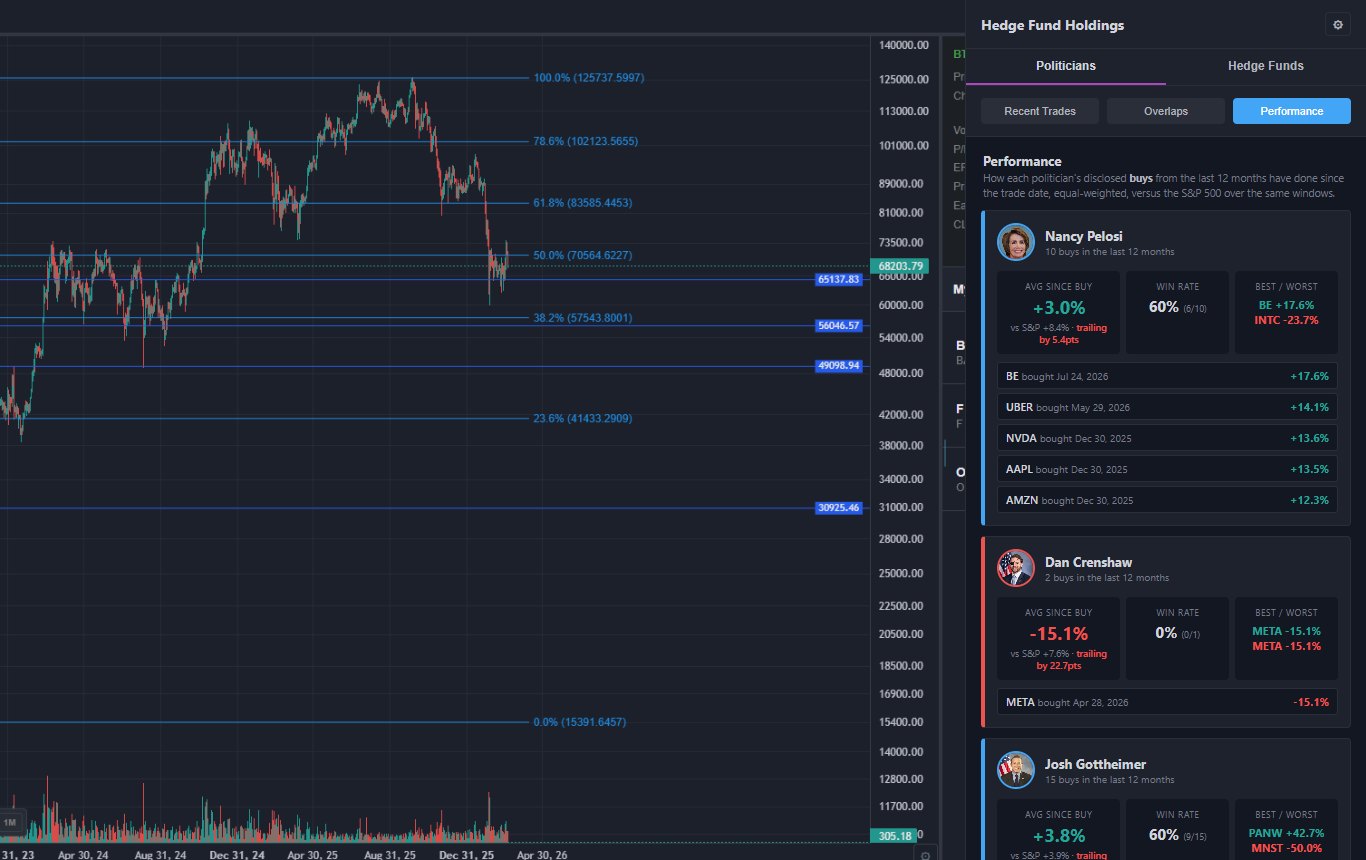
The politician Performance view in ChartingLens, August 2026. Returns are equal-weighted per stock because disclosed amounts are ranges.
The way to use it is as a corroboration layer, not a signal on its own. A stock where insiders are buying with their own money, a tracked fund holds a position, and two or three members of Congress disclosed purchases in the same quarter is a very different research candidate from a stock with any one of those alone. Our dedicated guide on how to track politician stock trades walks through the filings, the ranges and the lag in detail.
Free tool: check what members of Congress bought and sold in the last 60 days with the free Congress stock tracker, including a most-bought-this-month summary.
Building an Insider Trading Strategy
The data from Form 4 and 13F filings is freely available and rich with signal. But turning it into a repeatable investment strategy requires discipline, context, and realistic expectations. Here is a framework for doing so.
Do Not Copy Blindly
This is the most important principle. Whether you are tracking corporate insider buys or replicating a hedge fund manager's portfolio, copying trades mechanically without understanding the context is a recipe for mediocre or worse results. The insider may have a different time horizon, risk tolerance, tax situation, or portfolio construction than you. Buffett can hold a position for ten years through 40% drawdowns. Can you?
Use Insider Data as a Starting Point for Research
The most effective approach is to treat insider activity as a screening tool. When you see significant cluster buying at a company, or when a hedge fund manager initiates a new position, use that as a signal to investigate further. Read the company's financial statements. Listen to the most recent earnings call. Understand the competitive landscape. Check the valuation. Use free stock charting software to analyze the technical picture. Add the strongest candidates to a dedicated insider-signal watchlist -- our guide on how to build a stock watchlist walks through the process. Only after your own research confirms the thesis should you consider acting on the insider signal.
Account for the Delay
The timing gap between an insider's action and your ability to act on it is a real constraint:
- Form 4: Filed within two business days, so the delay is minimal. You can often act on insider purchase data within a week of the transaction.
- 13F filings: Delayed by up to 45 days. By the time a hedge fund manager's new position is public, the stock may have already moved significantly. Academic research suggests that some of the "13F effect" -- the price bump that occurs when a famous investor's purchase is revealed -- dissipates quickly, but long-term fundamentals still matter.
For 13F-based strategies, focus on understanding why the investor bought, not just what they bought. If the thesis is still intact 45 days later, the opportunity may still be valid even if the price has moved.
Combine Multiple Data Sources
The strongest signals come from convergence. If a hedge fund manager initiates a new position, multiple corporate insiders at that same company are buying, the stock is technically oversold, and the fundamentals are improving -- that convergence of signals is far more powerful than any one data point alone. This is where integrating insider data with charting tools, earnings analysis, and AI-driven pattern recognition creates a genuine edge.
A Practical Workflow
1. Monitor insider buying feeds daily for unusual cluster buying or large CEO/CFO purchases. 2. Cross-reference with 13F filings each quarter to see if institutional money is flowing into the same names. 3. Conduct your own fundamental and technical analysis on the most compelling signals. 4. Size positions according to your conviction level and risk tolerance. 5. Review and update your thesis regularly as new filings come in.
Tools for Tracking Insider Trading & 13F Filings
The ecosystem of tools for tracking insider activity has matured significantly. Here are the major options, from free government databases to integrated trading platforms.
SEC EDGAR (Free)
The SEC's Electronic Data Gathering, Analysis, and Retrieval system is the definitive source. Every Form 4 and 13F filing ends up here. EDGAR's full-text search lets you look up any company or filer. The interface is functional but not user-friendly -- it is designed as a regulatory database, not an investment tool. Best used for verification and deep dives into specific filings.
OpenInsider (Free)
OpenInsider aggregates SEC Form 4 data into a clean, filterable table. You can filter by transaction type, insider title, purchase amount, and date range. It is one of the most popular free tools for screening insider purchases and is a good starting point for anyone new to tracking insider trades.
WhaleWisdom (Free + Premium)
WhaleWisdom specializes in 13F data. It tracks hundreds of institutional investors, lets you compare portfolios quarter over quarter, and identifies new positions and exits. The free tier provides basic 13F data; the premium tier adds more detailed analytics, historical tracking, and portfolio overlap tools.
ChartingLens
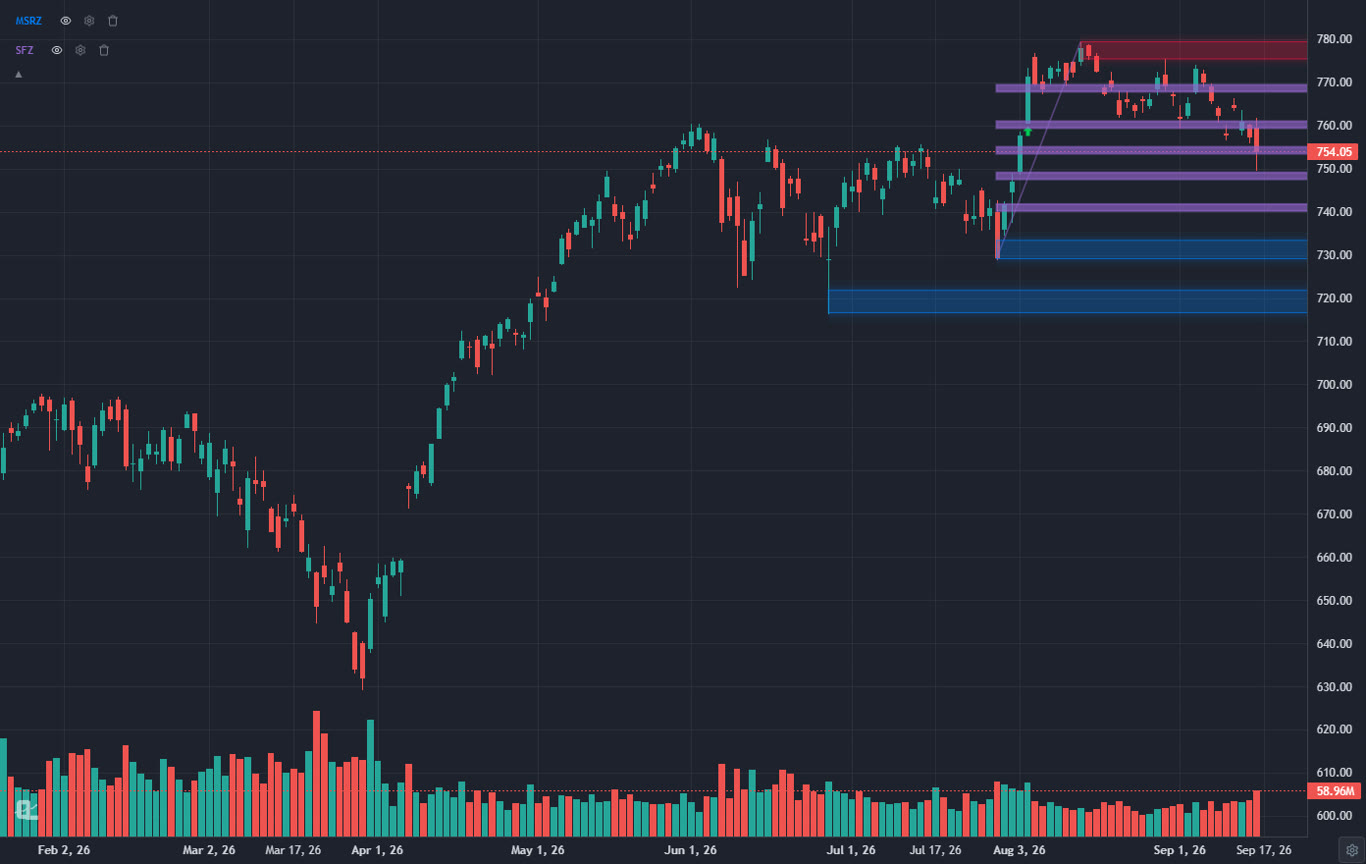
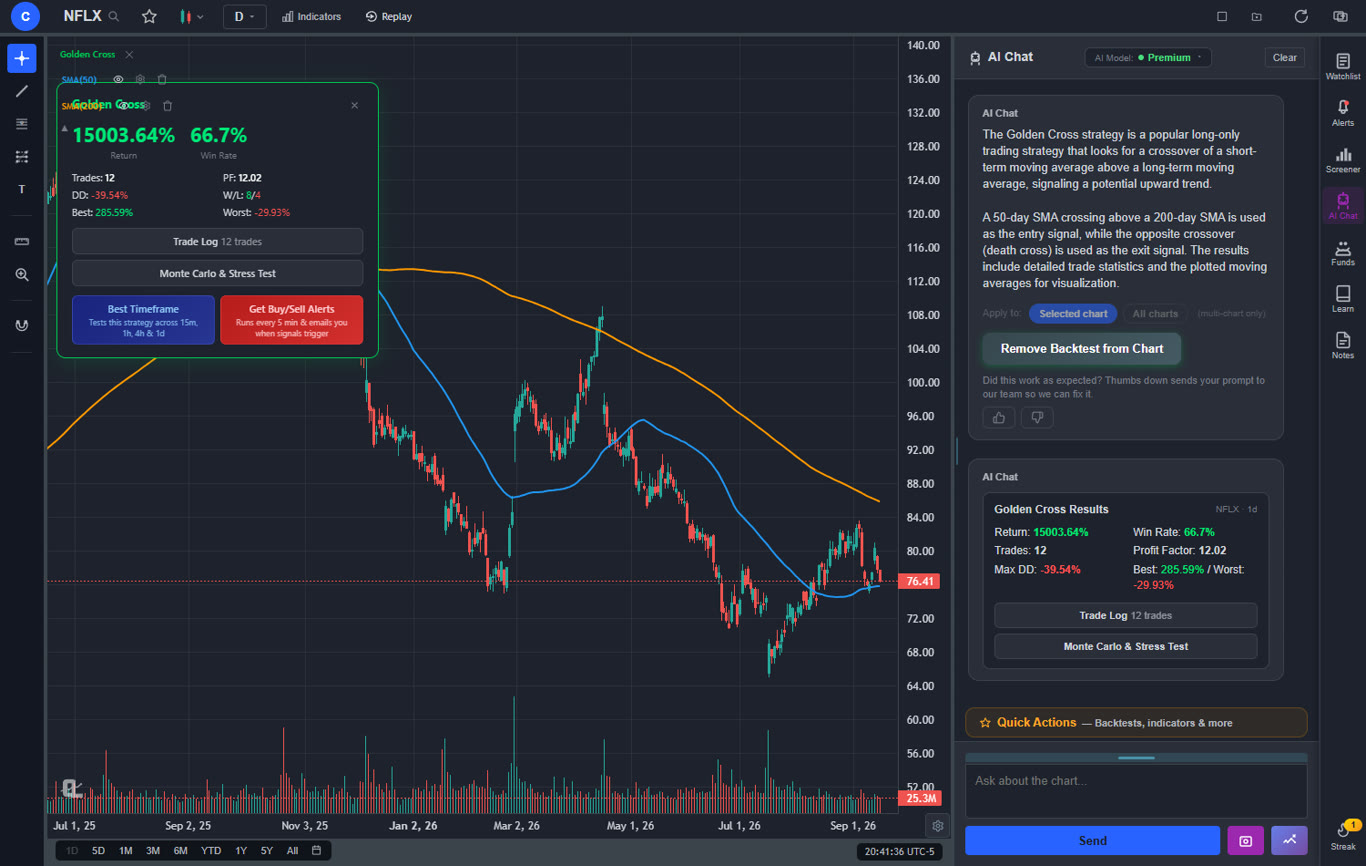
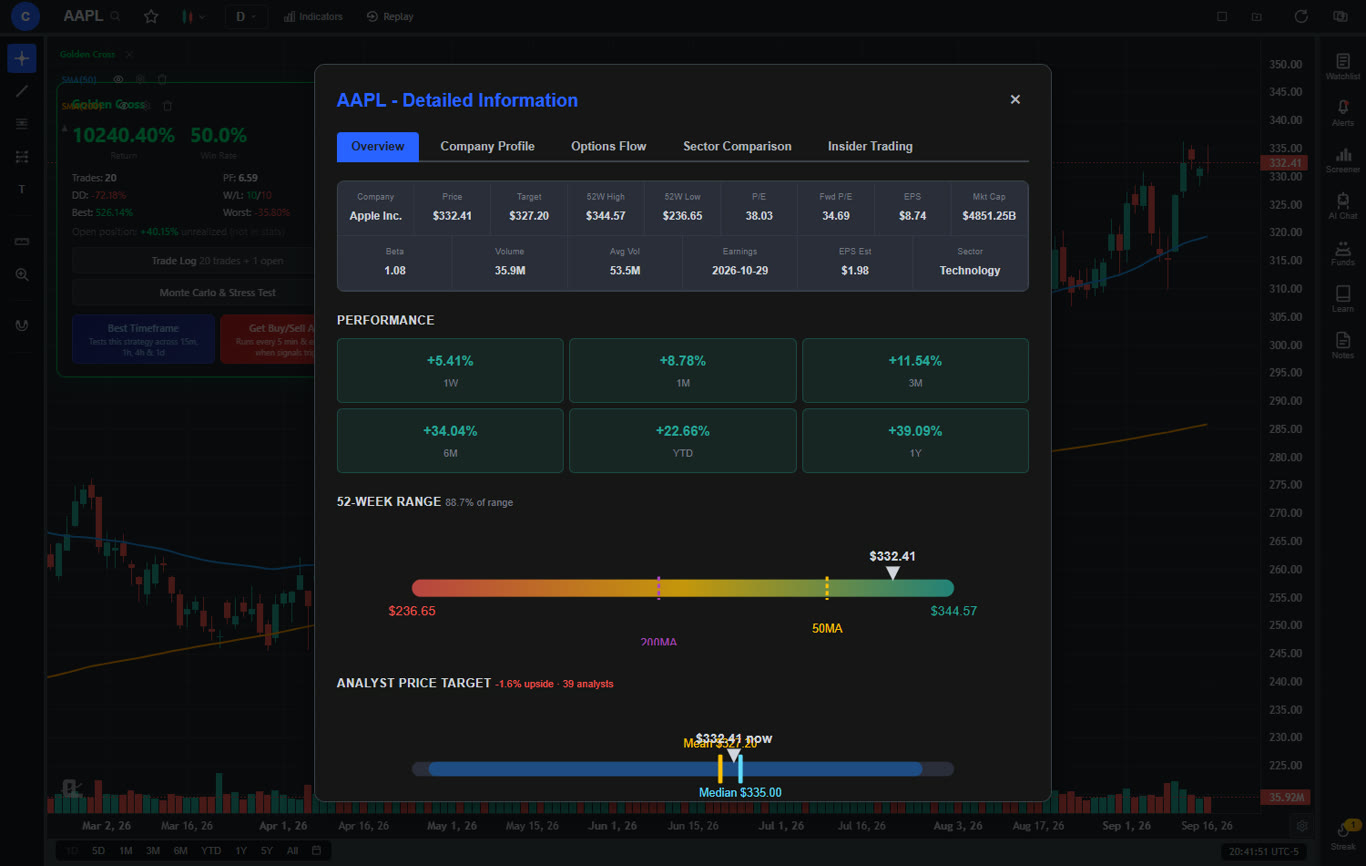
ChartingLens integrates insider trading data directly into stock pages, so you can see Form 4 filings alongside price charts, technical indicators, and fundamental data in a single view. Rather than switching between a charting tool and a separate insider tracking site, you get the full picture in one place. ChartingLens Premium also includes hedge fund holdings, letting you monitor the 13F holdings of investors like Buffett, Burry, and Ackman with quarter-over-quarter change alerts. For a walkthrough of all these features in action, see our guide on how to use ChartingLens.
The same panel now carries a Politicians tab: every trade disclosed by members of the House and Senate under the STOCK Act, parsed daily from the official filings, with Pelosi, Tuberville, Crenshaw, Gottheimer and 180-plus other members searchable, plus recent-trade, overlap and performance views. It is the only tool on this list that puts corporate insiders, Congress and 13F funds side by side on the chart.
Other Tools Worth Knowing
- Finviz: Free screener that includes insider trading data alongside fundamental and technical metrics.
- Dataroma: Tracks hedge fund holdings from 13F filings with a clean, no-frills interface.
- Insider Monkey: Combines insider trading data with hedge fund tracking and market commentary.
- GuruFocus: Provides 13F tracking, insider data, and valuation tools aimed at value investors.
The best tool depends on your workflow. If you want raw insider filing data, OpenInsider and EDGAR are excellent free options. If you want 13F portfolio tracking for hedge fund managers, WhaleWisdom and Dataroma are strong choices. If you want insider data and hedge fund holdings integrated directly into your charting and analysis platform, ChartingLens offers that unified experience.
Frequently Asked Questions
Is it legal to track insider trading?
+Yes. Tracking insider trading through publicly available SEC filings (Form 4 and 13F) is completely legal. These filings exist specifically to provide transparency to the public. The SEC mandates these disclosures so that all market participants can see what insiders and large institutions are doing. What is illegal is trading on material non-public information -- information that has not yet been disclosed through proper channels.
How quickly are insider trades reported?
+Corporate insiders must file SEC Form 4 within two business days of their transaction. This makes Form 4 data nearly real-time. 13F filings from institutional investors are due within 45 days of the end of each calendar quarter, so that data is significantly more delayed. For the most actionable signals, focus on Form 4 data for timeliness and 13F data for understanding the broader positioning of major investors.
Can I just copy Warren Buffett's portfolio?
+While you can replicate Buffett's publicly disclosed holdings, blindly copying is not advisable. 13F filings are delayed by up to 45 days, meaning prices may have already moved considerably. Buffett also manages a portfolio worth hundreds of billions of dollars with different risk tolerances, tax considerations, and time horizons than most individual investors. He can also negotiate special deal terms (like preferred shares with warrants) that retail investors cannot access. Use his filings as research input, not as a simple buy list.
What is the difference between Form 4 and 13F filings?
+Form 4 is filed by corporate insiders (officers, directors, and 10%+ shareholders) within two business days of buying or selling their own company's stock. It covers activity in a single company. 13F filings are quarterly reports from institutional investment managers with over $100 million in qualifying assets under management, disclosing their complete equity holdings across all companies. In short, Form 4 tells you what insiders are doing with their own company's stock, while 13F tells you what big institutional investors hold across their entire portfolio.
What is the best insider trading tracker?
+The SEC's EDGAR database is the primary free source for all insider trading filings. For more user-friendly analysis, tools like OpenInsider offer filterable Form 4 data, WhaleWisdom specializes in 13F tracking, and ChartingLens integrates both insider data and hedge fund holdings directly into its charting platform. The best tracker depends on whether you need raw data or prefer actionable analysis integrated into your trading workflow.
Can I track politician stock trades alongside insider trading?
+Yes. Members of Congress must disclose every stock trade over $1,000 within 45 days under the STOCK Act, and the filings are public through the House Clerk and the Senate eFD system. ChartingLens parses them daily into a Politicians tab in the same panel as its insider data and 13F hedge fund holdings, with buy and sell badges, size ranges, family-account tags, a recent-trades feed, overlap detection and performance since each disclosed buy versus the S&P 500. Because amounts are ranges and the lag can be 45 days, use them as a corroboration layer next to Form 4 and 13F data rather than a signal on their own. See our guide on tracking politician stock trades.
Do insider buys actually predict stock performance?
+Academic research generally shows that insider purchases -- particularly cluster buying by multiple insiders and large purchases by CEOs or CFOs -- tend to outperform the market over the following 6 to 12 months. Studies by Lakonishok and Lee (2001) and others have documented statistically significant excess returns following insider purchases. However, insider sells are less predictive because insiders sell for many non-informational reasons such as diversification, tax planning, or personal expenses. The signal is probabilistic, not guaranteed, and should be combined with your own analysis.
Related Articles
Track Insider Trading with ChartingLens
See insider buys, 13F holdings, and hedge fund holdings alongside real-time charts and technical analysis -- all in one platform.
Get Started FreeDisclaimer: This article is for educational and informational purposes only and does not constitute financial advice, investment advice, or a recommendation to buy or sell any security. Trading and investing involve risk, including the potential loss of principal. Past performance of any investor, strategy, or security does not guarantee future results. Always conduct your own research and consider consulting with a qualified financial advisor before making investment decisions. ChartingLens provides data and tools to assist your analysis but does not provide personalized investment recommendations.