Why Market Sentiment Matters
Markets are not purely rational. Prices do not simply reflect the sum of every available piece of fundamental data. Instead, they are shaped by fear, greed, optimism, panic, and every emotional state in between. Understanding market sentiment—the collective mood of investors at any given moment—gives traders an informational edge that pure price-and-volume analysis cannot provide on its own. The fear and greed index, the VIX index, the put call ratio, and a handful of other market sentiment indicators allow you to quantify what crowds are feeling and, more importantly, to act on that information before the crowd reverses.
There are two main schools of thought when it comes to trading with sentiment. The contrarian approach says that when the crowd is overwhelmingly bullish, the market is likely overbought and due for a pullback. When fear is extreme, it is often a buying opportunity. Warren Buffett's famous advice to "be fearful when others are greedy, and greedy when others are fearful" is the textbook contrarian philosophy. The momentum approach, on the other hand, says that sentiment trends can persist for longer than most people expect. If the crowd is bullish and money is flowing into stocks, riding that wave can be profitable as long as you manage risk and exit before the trend breaks.
Neither approach is universally right. The most effective traders combine both: they ride sentiment-driven momentum during trending markets and flip to contrarian positioning when sentiment reaches extremes. In this guide, we will break down every major market sentiment indicator you need to know, explain how each one works, and show you how to combine them into a practical trading framework. We will cover the fear and greed index, the VIX volatility index, the put call ratio, market breadth indicators, short interest data, the economic calendar, and sector rotation strategy—everything you need to read the market's emotional temperature in 2026.
What Is Market Sentiment?
Market sentiment is the prevailing attitude of investors toward a particular market, sector, or asset. It is the aggregate of millions of individual decisions—each influenced by news, personal experience, social media chatter, economic data, and raw emotion—condensed into observable patterns in price, volume, and positioning data. When the majority of market participants are optimistic, sentiment is said to be bullish. When pessimism dominates, sentiment is bearish.
Crowd Psychology and Sentiment Cycles
Markets move in sentiment cycles that are remarkably consistent across decades and asset classes. The cycle typically follows a pattern: disbelief, hope, optimism, euphoria, anxiety, denial, panic, capitulation, and then back to disbelief. Each stage corresponds to a measurable shift in sentiment data. During the euphoria phase, you will see the fear and greed index pinned near extreme greed, the VIX at historically low levels, and the put call ratio showing heavy call buying. During capitulation, every one of those indicators flips to the opposite extreme.
The reason these cycles repeat is rooted in human psychology. Behavioral finance research has documented dozens of cognitive biases that distort investor decision-making: herding behavior (following the crowd), loss aversion (feeling losses twice as strongly as gains), recency bias (overweighting recent events), and anchoring (fixating on specific price levels). These biases do not disappear when markets evolve. They are hard-wired into how humans process risk and reward. That is precisely why sentiment analysis remains effective: it measures the aggregate output of biases that never go away.
How Sentiment Drives Prices
Sentiment affects prices through two primary mechanisms. First, it influences buying and selling pressure directly. When investors feel greedy, they buy more aggressively, pushing prices higher. When fear takes hold, selling intensifies, driving prices down. Second, sentiment shapes expectations. If traders expect a stock to keep rising, they bid up the price preemptively, creating a self-fulfilling prophecy until the sentiment shifts. This feedback loop is why sentiment extremes tend to mark turning points: once everyone who wants to buy has already bought, there are no more buyers left to push prices higher, and the reversal begins.
The practical implication is clear: if you can measure sentiment accurately and identify extremes, you can position yourself ahead of the crowd's inevitable reversal. The tools we cover in the rest of this guide are how you do exactly that.
Fear and Greed Index
The fear and greed index is arguably the most widely referenced market sentiment indicator among retail and institutional traders alike. Created by CNN Business, it distills a broad set of market data into a single number on a scale from 0 to 100. A reading of 0 represents extreme fear, 50 is neutral, and 100 represents extreme greed. The index is updated daily and provides an instant snapshot of where investor emotion stands.
How the Fear and Greed Index Is Calculated
The CNN fear and greed index is built from seven equally weighted components, each capturing a different dimension of market sentiment:
- Market Momentum: The S&P 500 is compared to its 125-day moving average. When the index trades above this average and the gap is widening, it signals greed. When it falls below, it signals fear.
- Stock Price Strength: This measures the number of stocks hitting 52-week highs versus 52-week lows on the NYSE. A high ratio of new highs to new lows indicates greed; a low ratio signals fear.
- Stock Price Breadth: Trading volume in advancing stocks is compared to declining stocks (the advance/decline volume ratio). Strong advancing volume signals broad bullish participation, while heavy declining volume signals widespread selling.
- Put/Call Ratio: The ratio of put option volume to call option volume. A rising put/call ratio means more traders are buying downside protection (fear), while a falling ratio means more traders are betting on upside (greed).
- Market Volatility (VIX): The CBOE Volatility Index measures expected short-term market volatility. A rising VIX signals increasing fear, while a declining VIX signals complacency or confidence.
- Safe Haven Demand: The performance of stocks relative to Treasury bonds. When investors flee stocks for the safety of government bonds, it signals fear. When they sell bonds to buy stocks, it signals greed.
- Junk Bond Demand: The yield spread between junk bonds (high-yield corporate bonds) and investment-grade bonds. A narrowing spread means investors are comfortable taking on credit risk (greed). A widening spread means they are demanding a larger premium for risk (fear).
How to Read the Fear and Greed Index
Investors are in panic mode. Historically, extreme fear readings have coincided with market bottoms and strong buying opportunities for contrarian traders.
Pessimism is elevated but not at panic levels. Markets may still be declining, but the worst of the selling pressure is often fading.
The market is neither excessively fearful nor greedy. Sentiment is balanced, and price action is more likely to be driven by fundamentals and technicals.
Euphoria dominates. Contrarian traders view extreme greed as a warning sign that the market is overbought and vulnerable to a correction.
Historical Examples
The fear and greed index has proven its value at major market turning points. In March 2020, during the COVID-19 crash, the index plunged to 2—deep extreme fear territory. The S&P 500 went on to rally over 100% from those lows within 18 months. In January 2018, just before the "Volmageddon" correction, the index hit 90+, signaling extreme greed. The S&P 500 dropped over 10% in the following weeks. In late 2021, repeated extreme greed readings preceded the 2022 bear market that saw the S&P 500 decline roughly 25%.
The pattern is consistent: extreme fear does not guarantee an immediate bottom, and extreme greed does not guarantee an immediate top, but these readings dramatically improve the probability of a reversal when combined with technical confirmation signals. Swing traders can use these extreme readings as a timing tool for multi-day positions.
Fear and Greed Index for Crypto
The concept has been adapted for cryptocurrency markets as well. The Crypto Fear and Greed Index, published by Alternative.me, uses a different set of inputs tailored to crypto: volatility, market momentum and volume, social media sentiment, Bitcoin dominance, and Google Trends data. The interpretation is similar—extreme fear in crypto markets has historically been a strong contrarian buying signal, while extreme greed often precedes sharp corrections. Given crypto's higher volatility, sentiment swings tend to be more dramatic, making the index particularly useful for timing entries and exits in Bitcoin and altcoins.
VIX Index (Volatility Index)
The VIX index, formally known as the CBOE Volatility Index, is one of the most important market sentiment indicators in existence. Often called Wall Street's "fear gauge," the VIX measures the market's expectation of 30-day forward-looking volatility, derived from the prices of S&P 500 index options. It does not measure past volatility; it reflects what options traders are pricing in for future volatility. When traders expect turbulence, they pay higher premiums for options protection, which drives the VIX higher. When confidence prevails, options premiums decline, and the VIX drops.
VIX Levels Explained
Markets are calm. Traders feel confident. Ironically, extended periods of low VIX can set the stage for sudden volatility spikes, as complacency leads to over-leveraging.
The historical average for the VIX sits around 19-20. This range represents typical market conditions where some uncertainty exists but no panic.
Traders are nervous. Markets are experiencing above-average uncertainty, often triggered by geopolitical events, earnings surprises, or economic data shocks.
The market is in panic. VIX readings above 35 have historically coincided with major sell-offs. During the 2020 COVID crash, the VIX spiked above 80. During the 2008 financial crisis, it reached 89.53.
The VIX as a Fear Gauge
The volatility index earns its "fear gauge" nickname because it has a strong inverse correlation with the S&P 500. When stocks fall sharply, the VIX spikes. When stocks rally steadily, the VIX declines. This relationship makes it an effective real-time measure of market stress. But the VIX also carries forward-looking information: a rising VIX before a market moves lower suggests that smart money is already buying protection, which can serve as an early warning signal.
One nuance that many traders miss is the concept of VIX mean reversion. The VIX tends to spike quickly and then gradually decline back toward its long-term average. This mean-reverting behavior creates opportunities: when the VIX spikes to extreme levels, traders who sell volatility (or buy the stock market dip) are betting on the statistically likely reversion to the mean. This is not a guaranteed trade, but the probability is in your favor over time.
How to Trade the VIX
You cannot trade the VIX index directly, but several instruments provide VIX exposure. VIX futures trade on the CBOE Futures Exchange. VIX ETFs and ETNs such as VXX (iPath Series B S&P 500 VIX Short-Term Futures ETN) and UVXY (ProShares Ultra VIX Short-Term Futures ETF) offer leveraged and unleveraged volatility exposure. VIX options allow traders to buy calls or puts on the VIX itself. However, trading volatility products requires a solid understanding of contango, backwardation, and the VIX term structure. These products experience time decay and structural decay that can erode value over time, making them suitable primarily for short-term tactical trades rather than buy-and-hold positions.
Key insight: Most experienced traders use the VIX as a timing signal for stock positions rather than trading VIX products directly. When the VIX spikes above 30, historical data shows that buying the S&P 500 and holding for 12 months has produced positive returns a significant majority of the time.
Put/Call Ratio
The put call ratio is one of the simplest yet most effective sentiment indicators available. It measures the volume of put options traded relative to call options. A put option gives the holder the right to sell a stock at a specified price, functioning as a bearish bet or insurance against a decline. A call option gives the right to buy, functioning as a bullish bet. By comparing the volume of puts to calls, you get a real-time read on whether the options market is skewing bearish or bullish.
Reading the Put/Call Ratio
The put call ratio is calculated as: Total put volume / Total call volume. A ratio of 1.0 means equal put and call volume. The CBOE publishes daily put/call ratio data for total options (equity + index), equity-only options, and index-only options. The equity-only ratio is generally preferred for sentiment analysis because index options include heavy institutional hedging that can skew the data.
- Below 0.7: Excessive bullishness. More calls are being bought than puts. Traders are aggressively betting on upside. Contrarians view this as a potential warning that the market is too optimistic.
- 0.7 to 1.0: Normal range. A balanced mix of bullish and bearish positioning.
- Above 1.0: Elevated fear. More puts are being bought than calls. Traders are hedging heavily or betting on downside. Contrarians see this as a potential buying opportunity.
- Above 1.2: Extreme fear. Put buying has reached levels that historically precede market rebounds. This is one of the strongest contrarian buy signals in the options market.
Extreme Readings as Contrarian Signals
The put call ratio is most useful at its extremes. When the ratio spikes above 1.2, it means that the options market is pricing in significant downside risk. Historically, these spikes have occurred near short-term market bottoms. The logic is straightforward: when nearly everyone is buying insurance against further declines, the selling pressure is exhausted, and the market is primed for a reversal.
Conversely, when the put call ratio drops below 0.6, it means traders are overwhelmingly bullish and buying calls with little regard for downside protection. This complacency often precedes pullbacks. In late 2021, the equity put/call ratio dropped to multi-year lows as retail traders aggressively bought call options on meme stocks and speculative names. The market peaked in early January 2022 and entered a bear market that lasted the entire year.
The best approach is to use a moving average of the put/call ratio (typically a 5-day or 10-day average) rather than reacting to single-day readings. This smooths out the noise from one-off large block trades and gives a clearer picture of the underlying sentiment trend.
Market Breadth Indicators
Market breadth indicators measure the degree of participation in a market move. A rally in the S&P 500 is far more sustainable when it is driven by broad participation across hundreds of stocks than when it is propped up by a handful of mega-cap names. Breadth indicators help you distinguish between healthy, broad-based trends and narrow, fragile ones—a distinction that is critical for timing entries, exits, and risk management.
Advance/Decline Line
The advance/decline (A/D) line is the most fundamental breadth indicator. It is a cumulative running total of the difference between the number of advancing stocks and declining stocks on an exchange (typically the NYSE). When more stocks are advancing than declining, the A/D line rises. When more are declining, it falls. A healthy bull market is confirmed when the A/D line is making new highs alongside the S&P 500. One of the most reliable warning signs of a topping market is a divergence: when the S&P 500 makes a new high but the A/D line does not, it means fewer and fewer stocks are participating in the rally. This breadth divergence has preceded nearly every major market top in the past 50 years.
McClellan Oscillator
The McClellan Oscillator is a more refined breadth indicator derived from the difference between the 19-day and 39-day exponential moving averages of the daily advance/decline difference. It oscillates above and below zero, providing a momentum-style view of market breadth. Readings above +100 indicate an overbought breadth condition (strong but potentially stretched), while readings below -100 indicate an oversold condition (weak but potentially due for a bounce). The McClellan Summation Index, a cumulative version, is useful for identifying intermediate-term breadth trends.
New Highs vs. New Lows
Tracking the number of stocks making new 52-week highs versus new 52-week lows provides another lens on market breadth. In a strong bull market, new highs consistently outnumber new lows by a wide margin. When the market is rising but the number of stocks making new highs is shrinking while new lows are expanding, it is a red flag that the rally is losing momentum beneath the surface. Some traders use the "High-Low Index," calculated as new highs divided by the sum of new highs and new lows, where readings above 70% are bullish and below 30% are bearish.
Percentage of Stocks Above Their 200-Day Moving Average
This indicator measures the percentage of stocks in an index that are trading above their 200-day moving average, a widely used proxy for long-term trend health. When 70% or more of stocks are above their 200-day MA, the market has broad bullish participation. When less than 30% are above their 200-day MA, the market is in a widespread downtrend and nearing the type of oversold condition that contrarian traders look for. Extreme readings—above 80% or below 20%—often mark sentiment inflection points.
Practical tip: Market breadth indicators are most valuable when they diverge from the headline index. If the S&P 500 is at all-time highs but breadth indicators are deteriorating, it is a warning that the rally is narrowing and may be running out of fuel. This divergence signal has historically given traders weeks or even months of lead time before major corrections.
Short Interest Data & Most Shorted Stocks
Short interest data reveals how many shares of a stock have been sold short and not yet covered. When traders sell shares short, they are betting the price will decline. Elevated short interest tells you that a significant number of market participants have a bearish thesis on the stock. While this might seem straightforwardly negative, short interest data is actually a double-edged sword that savvy traders use for both risk assessment and opportunity identification.
Where to Find Short Interest Data
FINRA publishes short interest data twice per month, with a reporting delay of approximately 11 business days. You can access this data directly from FINRA's website or through aggregators. Yahoo Finance displays short interest for individual stocks under the "Statistics" tab, including short percentage of float. Finviz's stock screener allows you to filter by short float percentage, making it easy to scan for the most shorted stocks in the market. For more timely estimates, services like Ortex and S3 Partners provide daily estimated short interest updates based on proprietary modeling, though these require paid subscriptions.
Short Squeeze Potential
The most dramatic trading opportunities related to short interest data come from short squeezes. A short squeeze occurs when a heavily shorted stock begins to rally, forcing short sellers to buy shares to close their positions (cover their shorts), which creates additional buying pressure that drives the price even higher. The result is a violent upward spiral that can produce extraordinary gains in a short period. The GameStop (GME) short squeeze of January 2021 remains the most famous modern example: the stock rose from around $20 to nearly $500 in a matter of days, fueled by massive short covering against a short interest that exceeded 100% of the float.
Identifying short squeeze candidates requires finding stocks with high short interest (generally above 20% of the float), a catalyst that could trigger buying (positive earnings, FDA approval, a viral social media campaign), and limited share availability for short sellers to borrow. Not every heavily shorted stock will squeeze, but when the conditions align, the moves can be explosive.
Days to Cover Ratio
The days to cover ratio (also called the short interest ratio) divides the total short interest by the stock's average daily trading volume. It estimates how many days it would take for all short sellers to cover their positions at normal trading volume. A days-to-cover ratio above 5 is generally considered high and suggests that if a squeeze begins, it could take an extended period for short sellers to exit, prolonging the upward pressure. Ratios above 10 indicate extremely crowded short positions with significant squeeze potential.
Smart money signal: ChartingLens's insider trading tracker adds a valuable layer to short interest analysis. When company insiders are buying shares in a stock that has high short interest, it creates a powerful contrarian signal: the people who know the company best are betting against the short thesis. This insider-versus-shorts dynamic has historically been a strong predictor of eventual short squeezes.
Economic Calendar
The economic calendar is an essential tool for every active trader, regardless of strategy. It lists all upcoming economic data releases, central bank announcements, and earnings reports that can move markets. Sentiment can shift dramatically in seconds when a key economic report surprises to the upside or downside, and traders who are unaware of the schedule risk being caught off guard by sudden volatility spikes.
Why Traders Track Economic Events
Economic data releases create some of the highest-volatility moments in the trading day. When CPI (inflation) comes in hotter than expected, the market may sell off on fears of aggressive Fed tightening. When jobs data (NFP) surprises to the upside during an economic slowdown, the market might rally on evidence of resilience. These are not just short-term reactions; major economic surprises can shift the narrative that drives sentiment for weeks or months. The economic calendar allows you to anticipate these events, plan your positioning, and decide whether to trade through them or step aside.
Key Reports Every Trader Should Know
- CPI (Consumer Price Index): Released monthly by the Bureau of Labor Statistics. The most closely watched inflation measure. Hotter-than-expected CPI readings typically pressure stocks lower (due to rate hike fears) and push the VIX higher. Cooler readings have the opposite effect.
- NFP (Non-Farm Payrolls): Released on the first Friday of each month. Measures the number of jobs added or lost in the U.S. economy, excluding the farm sector. A strong labor market can be bullish (economic strength) or bearish (Fed stays hawkish), depending on the broader context.
- FOMC Meetings & Fed Rate Decisions: The Federal Reserve's interest rate decisions and accompanying statements are among the most market-moving events on the calendar. The post-meeting press conference and the "dot plot" of future rate projections often trigger the largest intraday moves of the year.
- GDP (Gross Domestic Product): Released quarterly by the BEA. GDP growth figures confirm or challenge the prevailing narrative about economic expansion or contraction. Significant misses in either direction shift sector rotation patterns and overall sentiment.
- Earnings Season: While not a single event, the quarterly earnings season (roughly the first few weeks after each quarter ends) is when individual stock sentiment is most volatile. Companies that beat estimates and raise guidance can surge. Those that miss can collapse. Aggregate earnings trends also influence broader market sentiment.
Best Free Economic Calendar Tools
Several platforms provide free, comprehensive economic calendars. Investing.com offers one of the most popular free economic calendars, with filters by country, impact level, and date range. ForexFactory provides a clean, trader-focused calendar popular among forex and futures traders. TradingView integrates an economic calendar directly into its charting platform for paid users. MarketWatch and Bloomberg also publish free economic event schedules. The best economic calendar for you depends on which markets you trade and how much detail you need, but for most stock and options traders, Investing.com and ForexFactory cover the essentials without requiring a paid subscription.
Sector Rotation Strategy
Sector rotation strategy is built on a simple but powerful observation: different stock market sectors outperform at different stages of the economic cycle. By identifying where we are in the cycle and positioning your portfolio in the sectors most likely to outperform, you can improve returns while managing risk. Sector rotation is both a sentiment tool (it reflects where big money is flowing) and a tactical strategy (it tells you where to allocate).
How Money Flows Between Sectors in Market Cycles
The economic cycle is typically divided into four phases, each favoring different sectors:
- Early Recovery: The economy is emerging from recession. Interest rates are low, monetary policy is accommodative, and corporate earnings are beginning to rebound. Cyclical sectors lead the way: Consumer Discretionary (rising consumer confidence), Technology (new investment cycles), and Financials (steepening yield curve). These sectors tend to produce the strongest gains in this phase.
- Mid-Cycle Expansion: Growth is established and broadening. Corporate earnings are strong, credit is flowing, and employment is rising. Industrials, Materials, and Technology tend to outperform as capital expenditure increases and supply chains ramp up.
- Late-Cycle: The economy is mature. Inflation is rising, the Fed is tightening, and growth is slowing. Energy often outperforms (commodity prices peak), along with Healthcare (defensive, essential spending). Valuations stretch as investors chase remaining momentum.
- Recession: The economy contracts. Earnings decline, unemployment rises, and risk appetite evaporates. Utilities, Consumer Staples, and Healthcare outperform because they provide essential goods and services that people continue to consume regardless of economic conditions. These defensive sectors offer relative stability when cyclical stocks collapse.
Defensive vs. Cyclical Sectors
The core distinction in sector rotation is between cyclical and defensive sectors. Cyclical sectors (Technology, Consumer Discretionary, Financials, Industrials, Materials, Energy) tend to amplify economic trends: they rise faster in expansions and fall harder in contractions. Defensive sectors (Utilities, Consumer Staples, Healthcare, Real Estate) are more resilient during downturns because their revenue streams are tied to necessities rather than discretionary spending.
When money rotates from defensive sectors into cyclical sectors, it signals that institutional investors are growing more optimistic about the economy. When money flows the other direction—out of cyclicals and into defensives—it signals that big money is getting cautious. Tracking this rotation in real time gives you a window into what the largest and most sophisticated market participants are thinking.
Using Sector Heat Maps
Sector heat maps provide a visual representation of how different sectors and individual stocks are performing relative to each other. They display percentage changes using color coding (green for gains, red for losses) and sizing (larger blocks represent larger market caps). Tools like Finviz's map and TradingView's sector performance charts let you see at a glance which sectors are attracting capital and which are being sold. By monitoring these heat maps daily, you can identify rotation trends early and adjust your portfolio accordingly.
Sector rotation + sentiment: Combining sector rotation analysis with the fear and greed index creates a powerful framework. During extreme fear readings, money typically flows into defensive sectors. If you see early signs of rotation back into cyclicals while the fear and greed index is still in fear territory, it can be an early signal that the market is preparing to recover—a signal that arrives before the headline index moves.
How to Use Sentiment in Your Trading
Understanding individual sentiment tools is useful, but the real edge comes from combining them into a coherent trading framework. Here is how experienced traders integrate sentiment analysis into their decision-making process.
Combining Sentiment with Technical Analysis
Sentiment works best as a contextual overlay on top of technical analysis. Technical analysis tells you what the chart is doing: where support and resistance levels are, what patterns are forming, and whether momentum is accelerating or decelerating. Sentiment tells you why the chart is behaving that way and whether the current trend is likely to continue or reverse. When both align, the probability of your trade increases significantly.
For example, imagine you identify a bullish falling wedge pattern on a stock's daily chart. The stock is testing a major support level, and RSI is in oversold territory. Now you check the fear and greed index: it is at 18, deep in extreme fear. The put call ratio is above 1.2, showing heavy put buying. The VIX is elevated at 32. All of these sentiment signals confirm that the market is in a state of excessive pessimism, which historically is where buying opportunities emerge. Your technical setup now has sentiment confirmation, giving you higher conviction.
Sentiment as Confirmation, Not a Primary Signal
One of the most common mistakes traders make is using sentiment as a standalone trading signal. The fear and greed index can stay in "greed" territory for months during a strong bull market, and traders who sell every time greed appears will be stopped out repeatedly while the trend continues higher. Sentiment should confirm your existing thesis, not replace it. Use technicals to identify specific trade setups and entry points, then use sentiment to gauge whether the broader environment supports your trade direction.
Avoiding Common Mistakes
- Do not fight extreme sentiment for too long. Contrarian trading works best at sentiment extremes, not in the middle of the range. If the fear and greed index is at 55, there is no actionable contrarian signal. Wait for readings below 20 or above 80 before incorporating contrarian positioning.
- Do not ignore the trend. Sentiment can stay irrational longer than you can stay solvent. If the market is in a strong uptrend and the fear and greed index reads 75, that does not automatically mean you should sell. Greed can persist during secular bull markets. Use trend analysis to determine whether an extreme reading is likely to resolve with a reversal or a continuation.
- Use multiple sentiment indicators together. No single indicator tells the whole story. If the fear and greed index shows fear but the put call ratio is normal and the VIX is declining, the signal is mixed. Look for confluence—when multiple indicators align in the same direction, the probability of a correct read increases.
- Account for context. Sentiment readings during earnings season, FOMC meetings, or geopolitical events may be distorted by event-driven hedging rather than genuine directional conviction. Check the economic calendar before interpreting sentiment spikes.
Best Market Sentiment Tools in 2026
Here are the best platforms and tools for tracking market sentiment, ranked by the depth and quality of their sentiment-related features.
1. ChartingLens
ChartingLens provides the most integrated approach to market sentiment analysis among modern charting platforms. While it does not display a standalone fear and greed index gauge, its feature set gives traders multiple sentiment signals woven directly into the charting workflow.
AI Buy/Sell Signals as Sentiment Indicators: ChartingLens's AI-powered signals scan over 2,000 stocks to identify high-probability setups. These signals incorporate momentum, volatility, and trend data—all of which are core components of market sentiment. When AI signals cluster on the buy side during a market pullback, it suggests that algorithmic analysis is identifying value in the fear. When sell signals dominate, it confirms bearish sentiment is backed by deteriorating technicals.
Insider Trading Tracker as Smart-Money Sentiment: Perhaps the most unique sentiment tool on ChartingLens is its real-time insider trading tracker. Company insiders—CEOs, CFOs, and board members—are the ultimate "smart money." When insiders are buying shares of their own companies during a market sell-off, it is a powerful bullish sentiment signal that the people closest to the business believe the stock is undervalued. ChartingLens surfaces this data alongside your charts, making it easy to spot divergences between insider behavior and crowd sentiment.
Top Gainers/Losers as Momentum Sentiment: The top gainers and losers view provides a real-time snapshot of which stocks are attracting the most buying or selling pressure. During extreme fear, the losers list becomes crowded with panic selling. During extreme greed, the gainers list fills with speculative momentum names. Monitoring this daily gives you a pulse on market mood that complements broader indicators like the VIX.
AI Trading Assistant for Market Context: ChartingLens's AI trading assistant can answer questions about current market conditions, explain what is driving a particular stock's movement, and provide context on technical setups. This is particularly useful for less experienced traders who want to understand what the sentiment data means for their specific positions. No ads on any tier, and premium is just $14.99 per month.
2. CNN Fear & Greed Index
The original and most well-known market sentiment indicator. CNN's fear and greed index dashboard provides a clear, visual gauge of current sentiment along with historical charts showing how the index has moved over time. Each of the seven components is displayed individually, allowing you to see which factors are driving the overall reading. It is completely free, requires no account, and is updated daily. The downside is that it is a standalone web page with no charting integration, so you need to check it separately from your trading platform.
3. TradingView
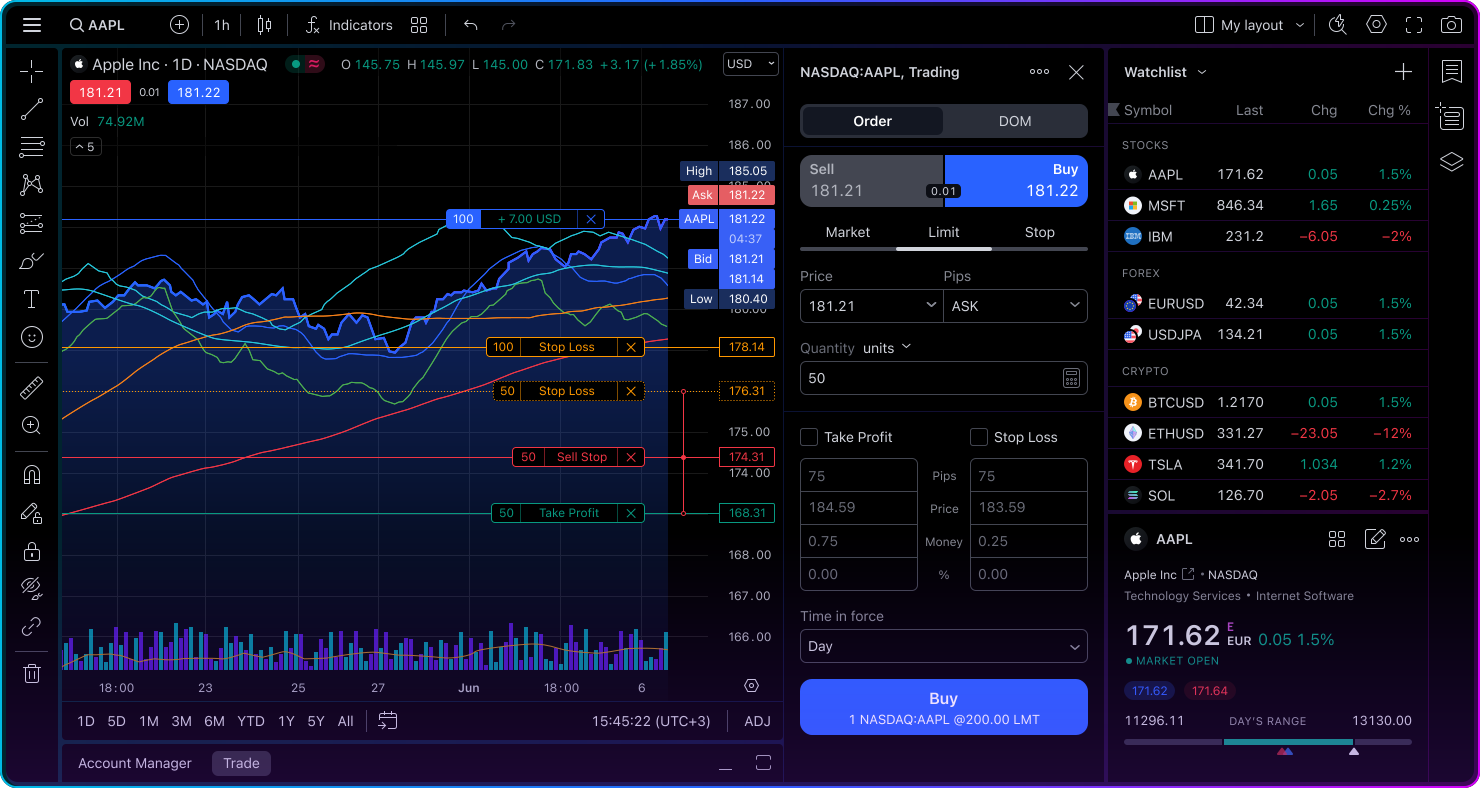
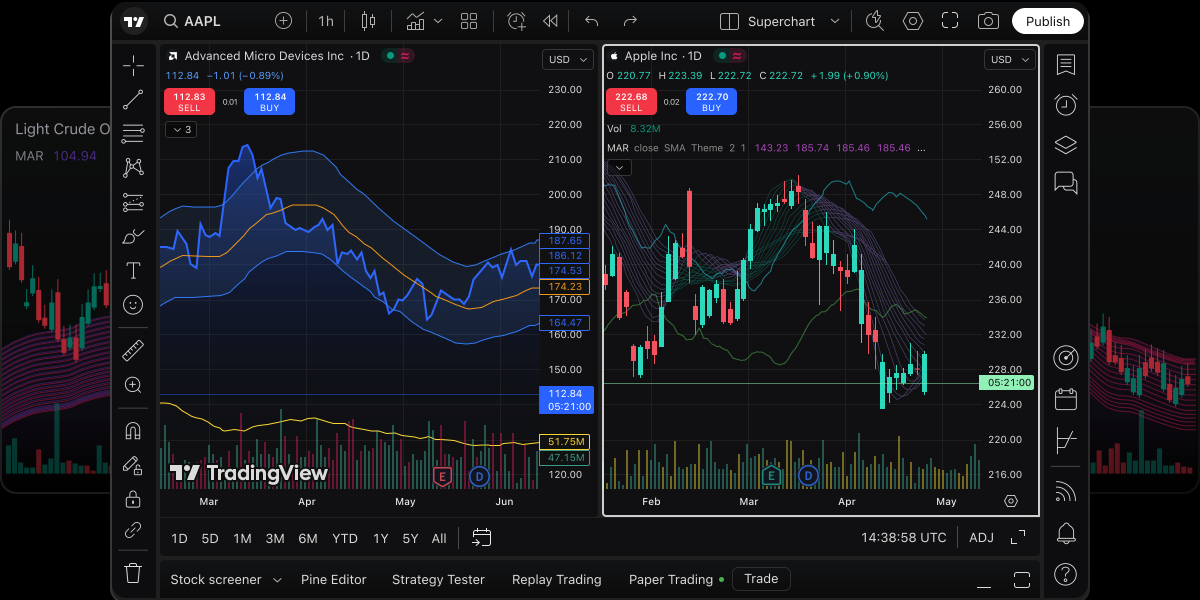
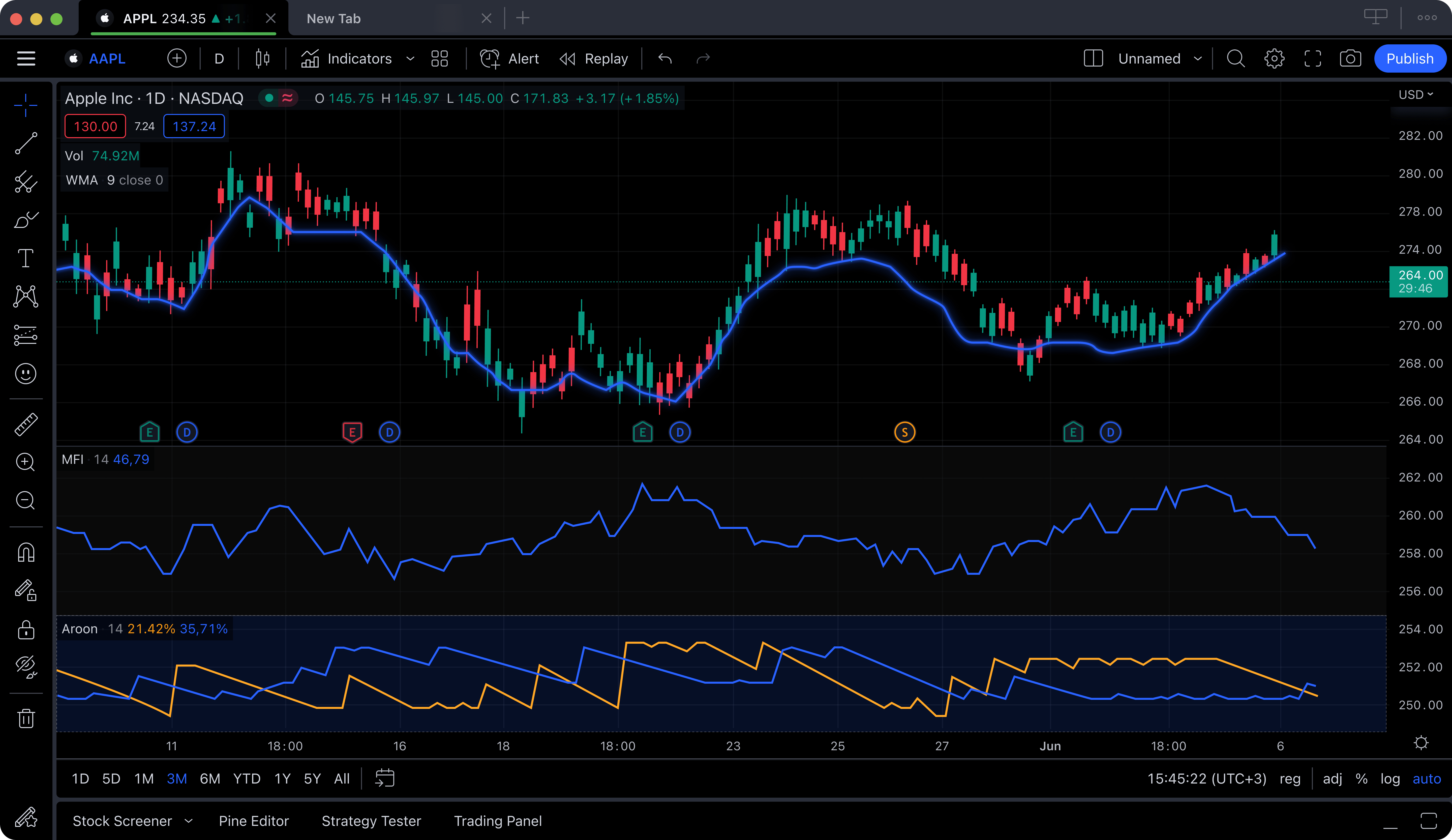
TradingView provides access to the VIX chart, put/call ratio data, and market breadth indicators through its charting platform and community-built indicators via Pine Script. Its social features add a crowd-sentiment dimension: you can see how many TradingView users are bullish or bearish on a given stock, which functions as a retail sentiment gauge. The platform also integrates an economic calendar (on paid plans) and offers heat maps for sector analysis. However, the free tier limits you to 1 indicator per chart, which makes it difficult to layer multiple sentiment indicators without upgrading.
4. Finviz
Finviz is best known for its powerful stock screener and sector heat map. The free tier lets you screen stocks by short float percentage (for finding the most shorted stocks), insider trading activity, and relative performance. The sector heat map provides an instant visual of sector rotation patterns. Finviz's screener is one of the fastest ways to identify short squeeze candidates by filtering for high short float, low days to cover, and recent price momentum. The Elite tier adds real-time data, advanced screening filters, and backtesting. Finviz does not offer charting tools competitive with dedicated platforms, so most traders use it as a screening complement to their primary charting software.
Frequently Asked Questions
Conclusion
Market sentiment is not a crystal ball, but it is one of the most powerful edges available to individual traders. The fear and greed index gives you a daily emotional temperature check on the market. The VIX index quantifies the fear priced into options. The put call ratio reveals how the options market is positioning. Market breadth indicators show you whether a trend has broad support or is running on fumes. Short interest data highlights where crowded bets create squeeze potential. The economic calendar keeps you ahead of the catalysts that shift sentiment. And sector rotation strategy helps you position your capital where institutional money is flowing.
The traders who consistently outperform are not the ones who react to sentiment—they are the ones who measure it, contextualize it, and act before the crowd catches on. By combining the sentiment tools and frameworks covered in this guide with solid technical analysis, you can make more informed decisions, avoid emotional traps, and identify opportunities that most traders miss.
Whether you are a contrarian looking to buy fear and sell greed, or a momentum trader riding sentiment trends, the key is having the right tools to see what others cannot. Platforms that integrate sentiment signals directly into your charting workflow—like AI-driven analysis, insider trading data, and real-time momentum tracking—give you a structural advantage over traders who rely on price charts alone.
Related Articles
Trade Smarter with Sentiment Signals
Get AI-powered buy/sell signals, insider trading data, and real-time momentum analysis. See what smart money is doing before the crowd reacts.
Try ChartingLens Free