How AI Is Changing Trade Idea Discovery
For decades, finding good trade ideas meant the same thing: manually scanning charts, reading analyst reports, watching financial news, and hoping you spotted something before the crowd. It was tedious, time-consuming, and limited by how many tickers one person could realistically review in a day. In 2026, that process has fundamentally changed. Trade Ideas AI platforms and AI-powered trading tools have turned what used to be a manual hunt into an automated, data-driven pipeline that surfaces actionable opportunities across thousands of stocks in seconds.
The shift is not just about speed. Every AI trade starts with better data. Machine learning models can ingest and cross-reference price action, volume patterns, fundamental metrics, news sentiment, and insider activity simultaneously -- something no human trader can do at scale. The result is a new class of trade ideas that are not based on gut feeling or a single indicator but on multi-dimensional analysis of market conditions.
Whether you are a day trader looking for momentum setups, a swing trader hunting for high-probability entries, or a long-term investor screening for undervalued stocks, an AI trading assistant can dramatically expand the universe of opportunities you consider. This guide explores how AI trade idea generation works, reviews the best platforms available in 2026 -- including the original Trade Ideas platform and its Holly AI system -- and gives you a practical framework for evaluating and using AI assisted trading ideas in your own workflow.
AI trade idea platforms do not replace your judgment. They expand your field of vision by scanning thousands of stocks across multiple data dimensions, surfacing the setups most likely to align with historically profitable patterns. The best traders in 2026 combine AI-generated ideas with their own analysis and risk management.
What Are AI Trade Ideas?
AI-generated trade ideas are actionable stock, ETF, or crypto picks surfaced by machine learning models that analyze price action, volume, fundamentals, and sentiment data. Unlike traditional screener output, which simply filters stocks by static criteria you define (such as "P/E under 15" or "RSI below 30"), AI trade ideas are scored and ranked by models that have learned from historical outcomes.
Think of the difference this way: a traditional screener is like a search engine that returns everything matching your keywords. An AI trade idea generator is more like a recommendation engine that says, "Based on everything I have learned from analyzing millions of historical setups, here are the opportunities that look most promising right now, and here is why."
The "why" part matters. The best AI trade idea platforms do not just output a ticker symbol and a "buy" label. They provide context: the pattern that triggered the signal, the confidence score based on historical accuracy, relevant support and resistance levels, and the expected time horizon. This transparency is what separates a useful AI stock trading assistant from a black box that asks you to trust it blindly.
AI trade ideas can cover multiple strategies and timeframes. Some platforms focus on intraday momentum trades, identifying stocks with unusual pre-market volume or breakout patterns forming in real time. Others focus on swing trade setups that may take days or weeks to play out. Still others apply AI to fundamental analysis, scoring stocks on the probability of earnings beats or long-term value appreciation. The common thread is that machine learning, not manual rules, drives the selection and ranking process.
A traditional screener tells you what meets your criteria. An AI trade idea system tells you what is most likely to work and why, based on pattern recognition across years of historical data.
How AI Generates Trade Ideas
Understanding what happens under the hood helps you evaluate which tools are worth your time and which are just wrapping basic screeners in AI marketing language. Here are the core technical processes that power legitimate AI assisted stock trading idea generation.
Pattern Recognition Across Thousands of Charts
The most foundational capability of any AI trade idea system is pattern recognition at scale. While a human trader might review 50 to 100 charts in a focused session, AI models scan thousands of charts across multiple timeframes in seconds. They identify formations like bull flags, cup and handle patterns, head and shoulders setups, ascending triangles, and dozens of other patterns -- including subtle, multi-variable configurations that the human eye would likely miss.
Modern deep learning models go beyond matching textbook patterns. They learn from millions of historical examples what variations of a pattern tend to lead to profitable outcomes and which tend to fail. A bull flag on high relative volume in a trending sector has different statistical properties than a bull flag on declining volume in a choppy market, and AI models can capture these nuances.
Multi-Factor Scoring (Technical + Fundamental + Sentiment)
The best AI trade idea generators do not rely on a single dimension of analysis. They combine technical signals (price patterns, indicator readings, volume behavior), fundamental data (earnings growth, revenue trends, valuation metrics), and sentiment analysis (news tone, social media activity, analyst revisions) into a composite score. This multi-factor approach reduces the false positives that plague any single-indicator strategy.
For example, an AI might identify a stock forming a technical breakout pattern. Before surfacing it as a trade idea, the model also checks whether fundamentals support the move (is revenue accelerating?), whether sentiment is turning positive (are analysts revising estimates upward?), and whether the broader sector is showing relative strength. Only setups that score well across multiple dimensions get surfaced to the trader.
Anomaly Detection
Some of the most profitable trade ideas come from spotting something unusual before the market fully prices it in. AI excels at anomaly detection -- flagging stocks with unusual volume spikes, unexpected insider buying activity, sudden changes in options flow, or momentum shifts that deviate from normal behavior. These anomalies often precede significant price moves and are nearly impossible to detect manually across a universe of thousands of stocks.
Natural Language Analysis of News and Earnings
Natural language processing (NLP) models analyze earnings call transcripts, press releases, SEC filings, and financial news in real time. They quantify sentiment, detect tone shifts compared to previous quarters, and flag material information that might affect a stock's price. An AI trading assistant using NLP can tell you not just that a company reported earnings, but whether management's language was more cautious than last quarter, whether guidance contained unexpected qualifiers, and how the market is likely to interpret the results based on historical analogs.
Historical Backtesting to Validate Ideas
Before surfacing a trade idea, robust AI systems backtest the signal against historical data. They ask: "When this exact combination of factors has occurred in the past, what happened next?" This backtesting provides a statistical foundation for the idea -- not a guarantee, but a probability framework. Platforms that publish their track record transparently give you the data to evaluate whether their AI's historical edge holds up in real market conditions.
Legitimate AI trade idea generation involves five layers: pattern recognition at scale, multi-factor scoring, anomaly detection, natural language analysis, and historical backtesting. If a platform cannot explain how its AI works across these dimensions, be skeptical of its claims.
Types of AI Trade Idea Platforms
Not all AI trade idea platforms work the same way. Understanding the different categories helps you choose the right tool for your trading style and experience level.
AI Signal Generators
These platforms output specific buy and sell signals with confidence scores, price targets, and stop-loss levels. They are designed for traders who want clear, actionable ideas they can evaluate and execute. The AI does the scanning and scoring; you make the final decision. Examples include ChartingLens AI Buy Signals and Tickeron's AI predictions.
AI Trading Assistants (Conversational)
An AI stock trading assistant lets you interact with market data using natural language. You can ask questions like "What are the strongest breakout setups in tech this week?" or "Explain the recent price action in NVDA and whether it looks bullish." The assistant processes your question, pulls relevant data, and provides an informed response. This category has grown rapidly thanks to advances in large language models. Well-established platforms like ChartingLens offer built-in AI trading assistants that combine conversational AI with real market data.
AI Screeners
AI-powered screeners go beyond traditional filtering. Instead of just returning stocks that match your criteria, they use machine learning to rank results by predicted performance. You get a prioritized list where the top ideas have the highest composite AI scores. This is ideal for traders who want a daily watchlist generated by data rather than intuition.
Fully Automated AI Traders
These platforms take AI trade ideas to the next level by executing trades automatically without human intervention. The AI identifies the setup, determines position size, enters the trade, and manages the exit. While powerful, fully automated systems require deep trust in the underlying model and carry additional risks. Most retail traders are better served by AI-assisted approaches where they retain final decision-making authority.
Best Platforms for AI Trade Ideas
The AI trade idea landscape in 2026 includes platforms for every budget and trading style. Here is a breakdown of the most notable options, including how each generates and delivers AI-powered trade ideas.
ChartingLens
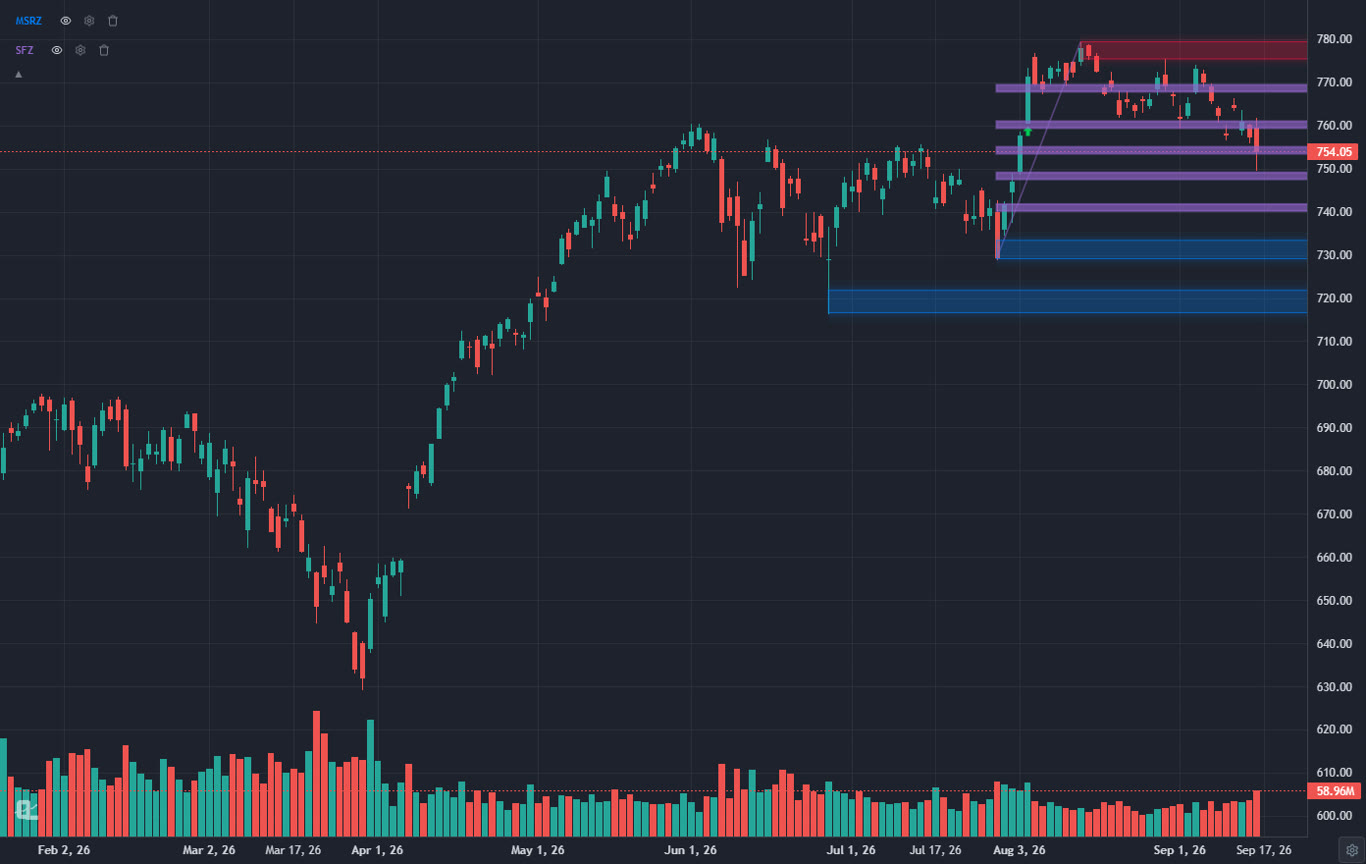
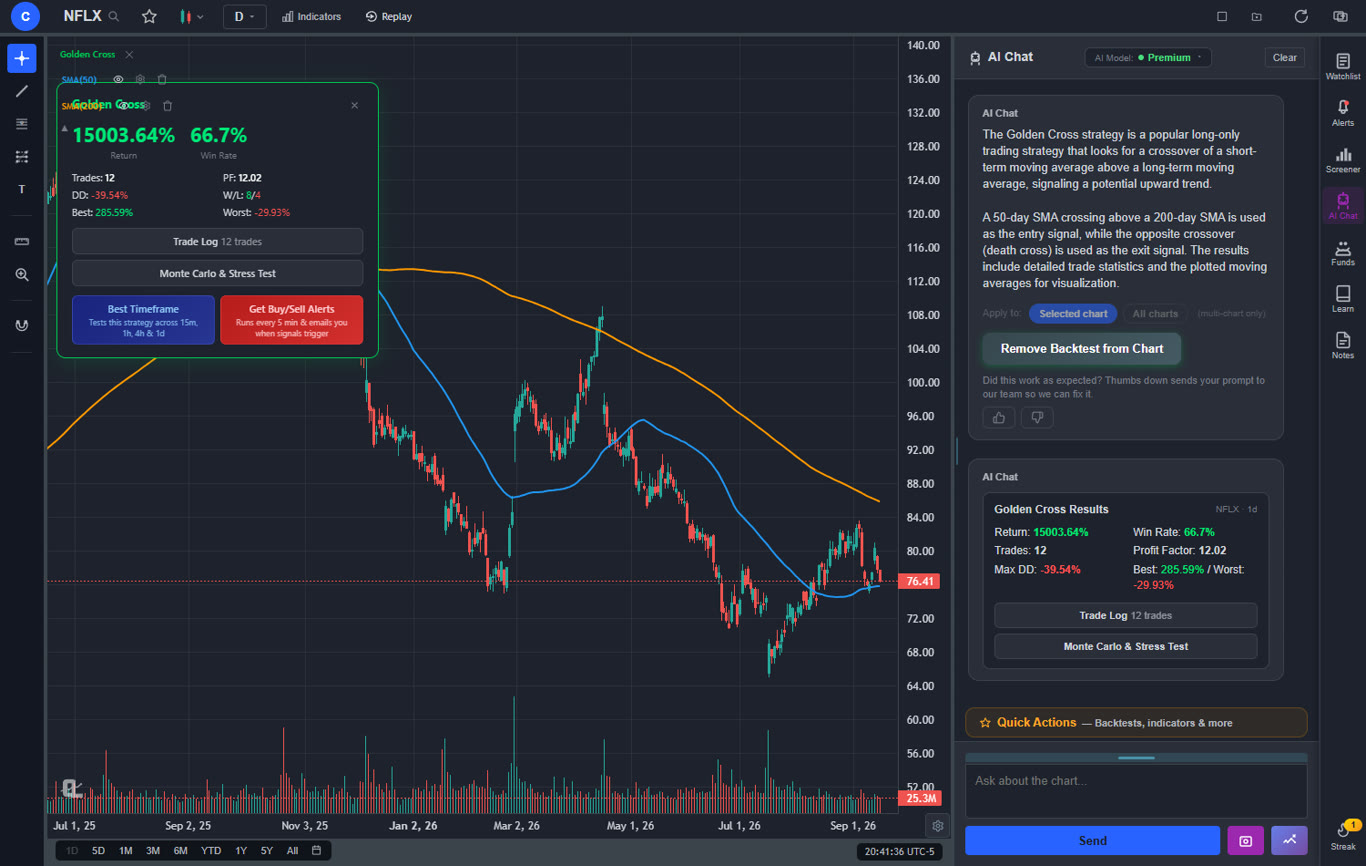
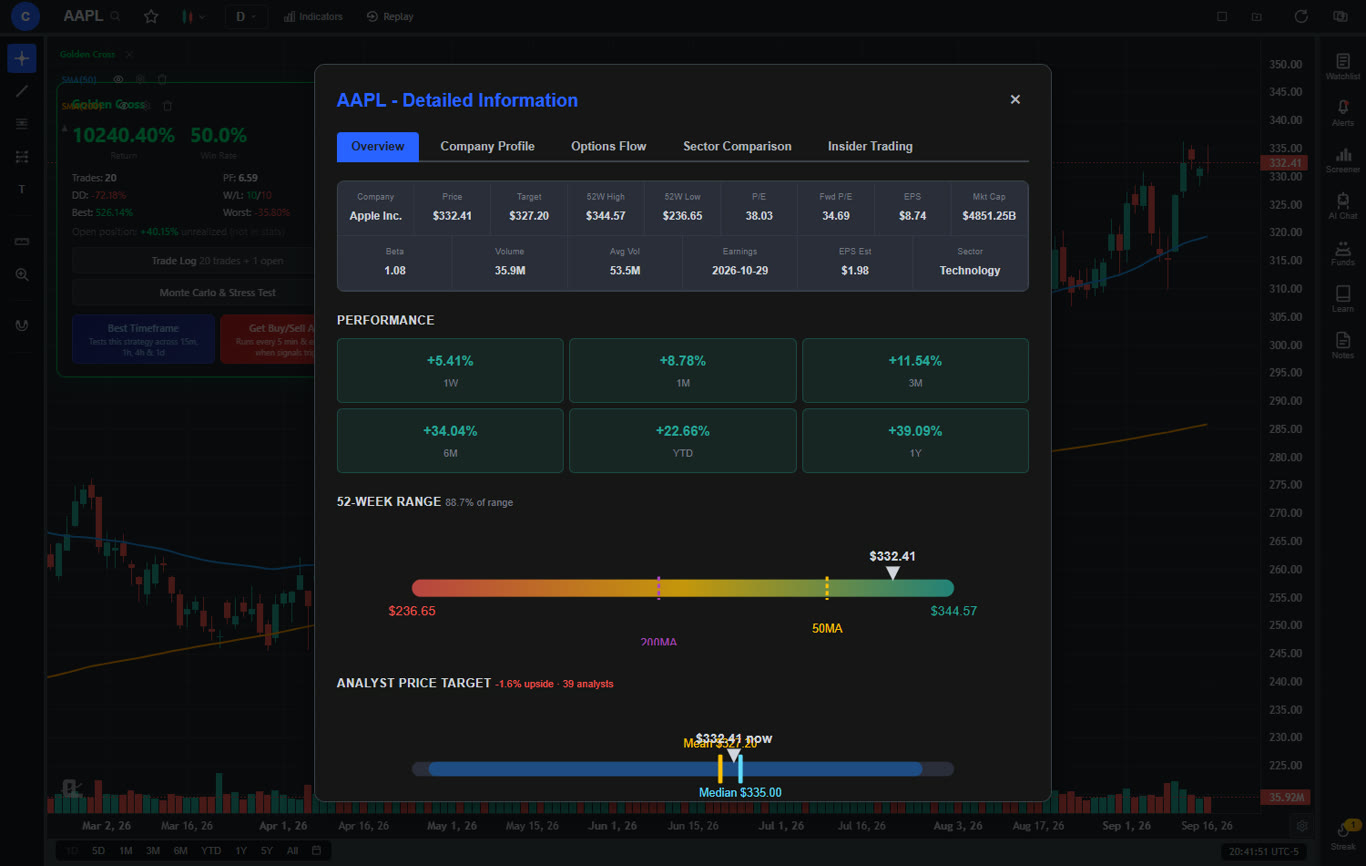
ChartingLens is a well-established trading platform with a large active user base that scans 2,000+ stocks daily using its AI buy signal engine, delivering 25 fresh signals a day with Day-N freshness badges alongside a proprietary 0-100 CL Score that ranks every idea by predicted strength. The built-in AI trading assistant answers verdict-first in natural language: ask "Is AAPL a buy right now?" and you get a decisive call with entry, stop, and targets; ask "Can you look at My Growth Watchlist and tell me which ticker is likely the best opportunity" and it evaluates the whole list. Ask "Can you give me an indicator that has buy and sell signals" and its AI Signal Tournament backtests seven classic strategies on your exact chart and timeframe, ranks them by win rate, return, and profit factor, and applies the winner in one click. Its institutional-grade strategy builder and institutional-grade backtesting engine turn plain-English strategy descriptions into full backtests with complete statistics -- and any custom indicator the AI builds with buy/sell signals can be armed as a live alert straight from the chart legend, notifying you (on-screen, sound, or email on Premium) each time a new signal prints on a closed bar. Unlike many competitors, ChartingLens bundles AI signals, an AI assistant, and professional charting in a single platform, and the free-forever tier -- no credit card required -- includes 2 daily AI credits, free preset indicators and backtests that cost no credits, and automatic support and resistance drawing; Premium is $14.99/mo and Pro ($29.99/mo) makes AI usage unlimited. For traders who want to verify performance before committing, ChartingLens publishes its full track record publicly -- the anti-black-box proof most AI tools never offer. It is one of the strongest options for anyone looking for free AI trading tools that genuinely deliver actionable ideas, and you can create a free account in under a minute.
Trade Ideas (Holly AI)
Trade Ideas is the original "Trade Ideas AI" platform, and its Holly AI system remains one of the most technically advanced tools available for day traders. Holly is an autonomous AI that backtests millions of trading scenarios overnight, selecting the strategies that performed best under current market conditions. Each morning, Holly presents a curated set of trade ideas with entry points, targets, and stops -- all based on strategies that passed rigorous statistical validation. The platform is expensive compared to alternatives, but for active day traders who make multiple trades daily, the depth and specificity of Holly AI's output can justify the cost. The learning curve is steep, and the interface is dense, so it is best suited for experienced traders who already understand technical analysis and want AI to supercharge their scanning process.
TradingView
TradingView is not primarily an AI platform, but its massive community of developers has created thousands of AI-powered Pine Script indicators and strategies that function as AI trade idea generators. Combined with TradingView's built-in screener and alert system, you can build a semi-automated AI workflow using community-contributed tools. The strength is the social element: you can see what ideas other traders are publishing and how the community is positioning. The weakness is quality control -- community scripts vary wildly in sophistication, and there is no centralized AI scoring system. Best for traders who enjoy tinkering and want a social dimension to their idea discovery.
Tickeron
Tickeron uses AI to identify chart patterns and assign confidence ratings to each trade idea based on historical pattern performance. Its AI generates predictions for individual stocks with probability scores and expected price targets. The platform covers stocks, ETFs, forex, and crypto, making it versatile for multi-asset traders. The free tier offers limited AI features, while paid plans unlock the full pattern recognition engine and real-time alerts. Tickeron is a solid mid-range option for traders who want structured AI trade ideas with clear probability metrics.
Danelfin
Danelfin takes a streamlined approach to AI trade ideas. It assigns each stock an "AI Score" from 1 to 10 based on technical, fundamental, and sentiment analysis. The interface is clean and accessible, making it ideal for traders who want quick AI-driven stock rankings without the complexity of advanced platforms. Danelfin is best used as a screening layer -- a way to quickly identify which stocks the AI considers strongest -- rather than a comprehensive trade planning tool. The free tier provides basic AI scores, while paid plans offer more detailed analysis and alerts.
How to Evaluate AI Trade Ideas
Getting access to AI trade ideas is the easy part. The harder and more important skill is knowing how to evaluate them before putting real money at risk. Here is a practical framework that works regardless of which platform you use.
Check the Track Record
Any platform claiming to generate AI trade ideas should be willing to publish its historical performance. Look for verified track records that include both wins and losses, not cherry-picked highlights. How have the signals performed across different market conditions -- bull markets, bear markets, and sideways chop? A platform that only shows bull market results is hiding something. ChartingLens publishes its full track record for exactly this reason.
Understand the Methodology
If a platform cannot explain how its AI generates trade ideas, treat it with skepticism. You do not need to understand the math behind neural networks, but you should understand the general approach: what data does the model use, what factors does it weight, and how often is it retrained? Transparency in methodology is a strong signal that the platform takes its AI seriously rather than using it as a marketing buzzword.
Cross-Reference with Your Own Analysis
Never take an AI trade idea at face value. Pull up the chart and do your own technical analysis. Check the fundamentals. Read the latest news. An AI assisted trading workflow works best when the AI surfaces the idea and you validate it with your own expertise. If the AI says "buy" but the chart looks like a falling knife with deteriorating fundamentals, trust your analysis and pass.
Manage Risk Regardless of AI Confidence
Even a high-confidence AI signal can be wrong. Always define your stop loss, position size, and risk per trade before entering any position. A 90% confidence score still means 1 in 10 trades will move against you. Position sizing and risk management are what keep you in the game long enough for your edge to compound. No AI stock trading assistant can replace disciplined capital management.
Paper Trade Before Going Live
Before committing real capital to any AI trade idea platform, spend at least two to four weeks paper trading the signals. Track every idea the AI generates, note which ones you would have taken, and compare outcomes. This gives you a personal dataset of experience with the platform's signals and helps you calibrate your trust level before money is on the line.
The traders who profit from AI trade ideas are not the ones who follow every signal blindly. They are the ones who use AI as a high-powered research assistant and then apply their own judgment, risk management, and market context to make the final call.
AI Trade Ideas vs. Human Analysis
The question is not whether AI or human analysis is better. It is understanding where each excels so you can combine them effectively. Here is an honest comparison.
Where AI Shines
Scale and speed. AI can scan every stock in the market across multiple timeframes and data dimensions in seconds. A human cannot. If you are trying to find the best setups across 5,000+ stocks, AI is the only practical solution.
Consistency. AI applies the same analytical framework every single time, regardless of market conditions, emotions, or fatigue. It does not get scared during a selloff or greedy during a rally. Every AI trade idea is generated with the same dispassionate rigor.
Pattern detection. AI excels at identifying subtle, multi-variable patterns that humans miss -- especially patterns that involve complex interactions between technical, fundamental, and sentiment data across multiple timeframes.
Data processing. An AI model can read and quantify sentiment from thousands of news articles, earnings transcripts, and social media posts in the time it takes you to read one analyst report. For traders who want to incorporate sentiment and crypto market data into their ideas, this capability is indispensable.
Where Humans Are Better
Contextual judgment. AI struggles with unprecedented events. A pandemic, a sudden geopolitical crisis, or a regulatory change that has no historical precedent will confuse models trained on past data. Experienced human traders can adapt to novel situations by reasoning about cause and effect, something current AI models do poorly.
Understanding narrative. Markets are driven by stories as much as by data. A human trader can understand why a particular earnings miss might actually be bullish (because expectations were irrationally low) or why a technical breakout might fail (because the broader macro picture is deteriorating). AI sees patterns; humans understand context.
Risk management discipline. While AI can suggest position sizes and stop levels, the discipline to actually follow through -- to cut a losing position when your ego wants to hold, to take profits when greed says to ride it further -- is fundamentally a human skill. No AI trading assistant can make you follow your own rules.
Why the Combination Wins
The most effective approach in 2026 is using AI for what it does best -- scanning, scoring, and surfacing ideas at scale -- and using human judgment for what it does best -- contextual reasoning, narrative understanding, and disciplined execution. This is the core philosophy behind AI assisted trading: the machine handles the data processing, and you handle the decision-making.
AI and human analysis are not competing approaches. They are complementary. AI expands the universe of ideas you consider and adds statistical rigor to your process. Your judgment, experience, and risk management turn those ideas into a profitable trading practice. Neither alone is as effective as both working together.
Frequently Asked Questions
Related Articles
Get AI-Powered Trade Ideas Free
ChartingLens scans 2,000+ stocks daily with 25 AI buy signals backed by a public track record, a verdict-first AI trading assistant, plain-English backtesting, and the CL Score ranking system. Free forever plan -- no credit card required.
Get Started Free